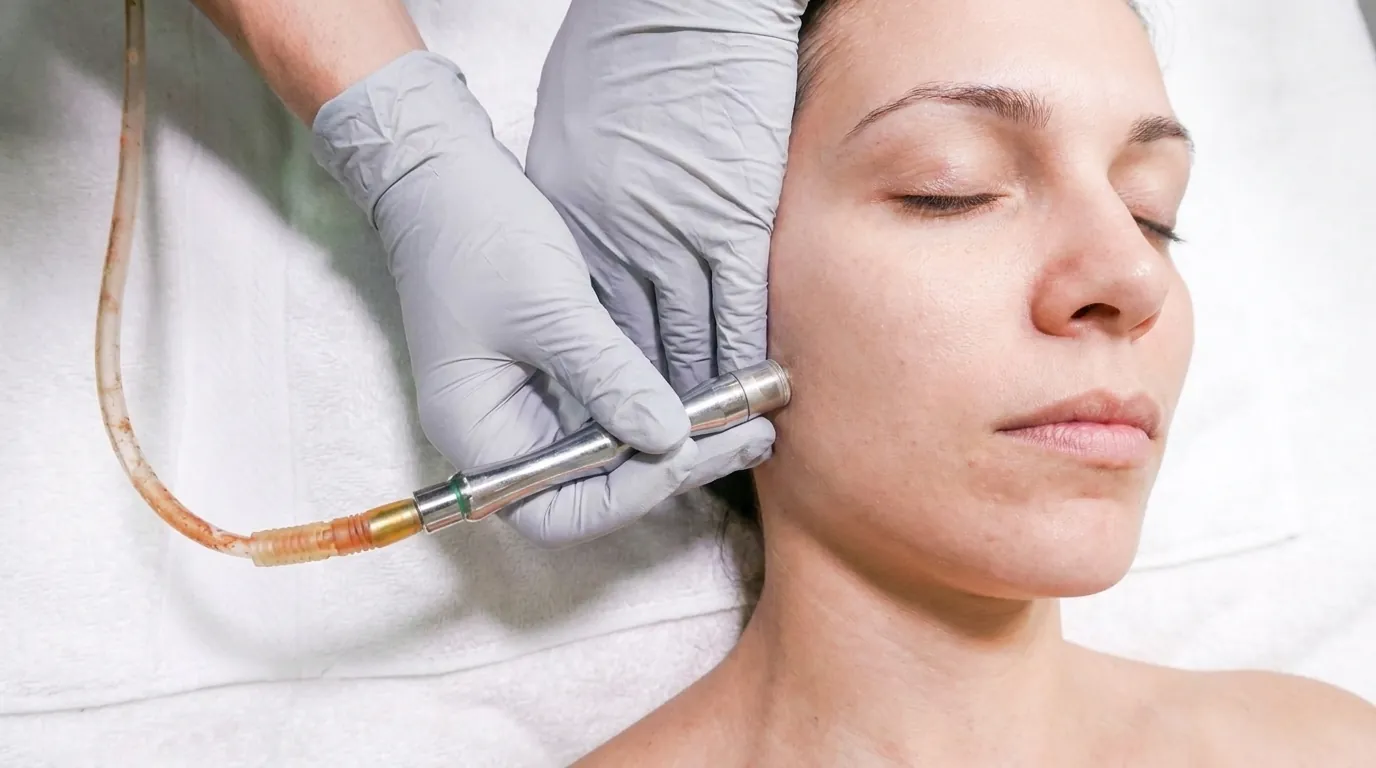
Dermaplaning vs Microdermabrasion
Dermaplaning is better if your main problem is dull skin and fine facial hair. A blade scrapes off the dead top layer, and the fuzz comes off with it. Microdermabrasion is better for congested pores and rough, bumpy texture. A machine sands and vacuums off dead skin only, and it works best as a course of visits. Both are surface treatments, and both wear off within about a month.
What actually happens
A sterile surgical blade is drawn across taut skin at a shallow angle. It shaves off dead cells and the fine vellus hair with them. It does not cut into living skin.
A wand with a rough diamond tip, or a spray of fine crystals, buffs the dead top layer away. A vacuum pulls the loosened skin and grit off as it goes.
What you get out of it
The change is there when you sit up. Makeup sits flatter because there is no hair for it to catch on.
One session gives a mild glow. The texture change people actually want usually takes a series of sessions, a few weeks apart.
What it will not do
A blade skims the surface. It does not pull anything out from inside a pore.
Microdermabrasion leaves vellus hair where it is.
How long it lasts
Dead skin builds back up, and the hair grows back to the length it was before.
Any lasting change comes from repeating it, not from one visit.
What it feels like
Most people call it strange rather than painful. Nothing is needed to numb the skin.
The suction is the part people notice. Mildly uncomfortable, not painful.
The downside
Small cuts happen if the angle or the pressure is wrong. Dragging a blade over inflamed spots can spread bacteria.
Redness for a day or two is normal. Some people break out briefly afterwards.
Cost
Often added to a facial for a small extra fee.
Ask what a full course costs, not just one visit.
The at-home or drugstore version
Face-shaving razors do the same job with a blunter blade. You get less exfoliation and more risk of nicks, but it is the same idea.
Home microderm kits are gritty scrubs, or a small suction wand. They sand far more lightly than a clinic machine, and the suction is much weaker.
Who each suits
No, the hair does not grow back thicker
Dermaplaning cannot change your facial hair: The blade cuts the hair at the skin. It does not touch the follicle underneath, and the follicle is what decides how thick and how dark a hair is. That is set by your genes and your hormones.
The regrowth feels different for a few days, and that is what starts the myth: A hair that grew naturally has a fine, tapered tip. A cut hair has a blunt end, so it feels stubbly to your fingers even though it is the same width and the same colour. Once it grows out past that blunt tip, it feels soft again.
Nothing you do to the surface of your skin turns vellus hair into coarse hair: If your facial hair genuinely gets darker or thicker over time, that is a hormonal change, and it would have happened whether or not you ever picked up a blade.
Which one is better for acne and oily skin
Microdermabrasion is the better fit of the two for oily, congested skin: It buffs down the plugs of dead skin sitting in the pore openings, and the suction lifts some of the loosened debris out. Skin often feels less greasy for a week or two afterwards.
Dermaplaning is the worse fit for oily, congested skin: It works on the flat surface between pores, so it does very little for blackheads. Some people also find that removing the fuzz makes their face feel oilier, because there is no hair to hold the oil off the skin.
Neither one is used on skin that is actively broken out: Sanding or scraping across inflamed spots can pop them, spread bacteria and leave marks. Clinics will usually ask you to wait until the skin has settled. For ongoing acne, a topical retinoid or a prescription is the treatment that changes anything; these two are for texture.
Both of these are short-term treatments
You are removing dead skin, and dead skin comes back: That is not a flaw in either treatment. It is what surface exfoliation is. Expect three or four good weeks and then a return to baseline.
Neither one builds collagen, fades deep pigment or softens a real wrinkle: If that is what you are after, a chemical peel, a laser or microneedling is the honest answer, and the price and the downtime go up with them.
Before you book
Ask who is doing it and how often they do it. Both are technique-dependent, and dermaplaning in particular is easy to do badly.
Say if you use a retinoid, or have used isotretinoin in the last six months. Either can change the plan.
Ask what the full course costs if you are being sold a package.
Book at least a week before an event, not the day before.