Scalp Psoriasis vs Dandruff
Flakes on your shoulders. An itchy scalp. Patches you can feel with your fingertips. Dandruff and scalp psoriasis look alike from a distance, and the shampoo aisle treats them as the same problem.
They are not. Dandruff is a reaction to yeast that lives on everyone's skin. Scalp psoriasis is your immune system working too fast. That is why an anti-dandruff shampoo can clear one in a few weeks and do almost nothing for the other.
Three things tell them apart: what the scale looks like, whether the patch has a clear edge, and whether anything similar is happening elsewhere on your body.
What it is
The immune system speeds up skin cell production. Cells pile up before the old ones shed, which builds a raised plaque. It runs in families and is not caused by anything you did or did not wash.
A yeast called Malassezia lives on everyone's scalp. In some people the skin reacts to what it produces, and that reaction causes flaking, redness and itch. Dandruff is the mild end of this. The more inflamed version is called seborrheic dermatitis.
What the flakes look like
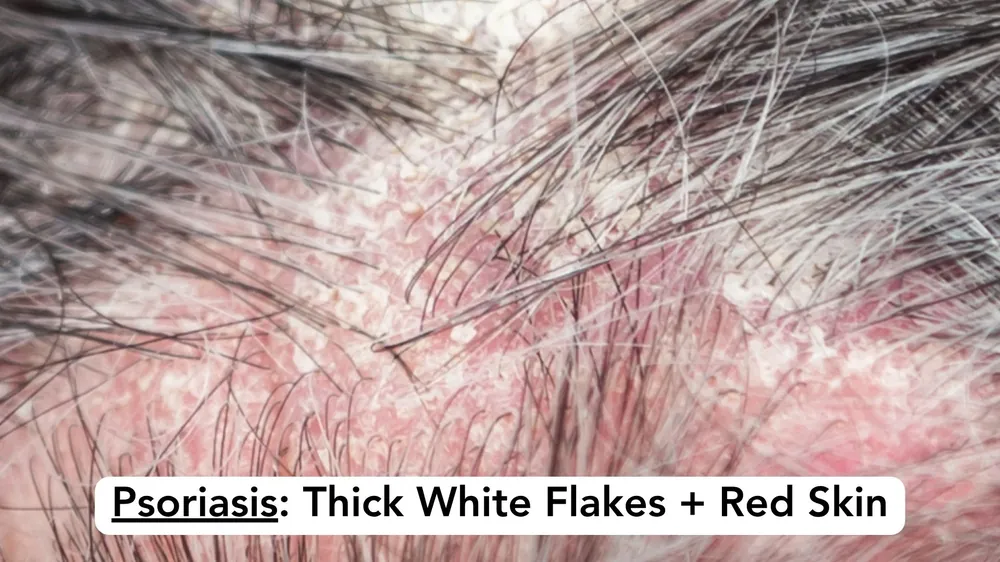
Scale sits in layers on top of the patch, dry and silvery-white. It often lifts off in a sheet rather than a dusting.
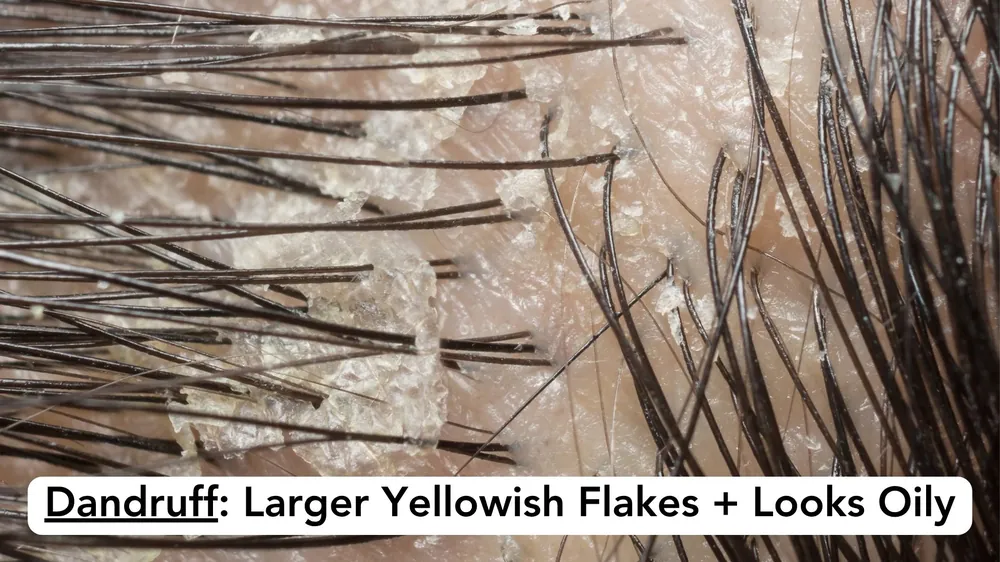
Flakes are smaller and looser, and look slightly oily or yellow-tinged. They fall easily onto clothes.
The edge of the patch
You can trace where the patch stops. Run a finger over it and there is a clear step up onto thickened skin.
The flaking fades into normal scalp with no clear border, and the skin underneath is not raised.
Where on the head it turns up
Psoriasis picks places and holds them. Each patch has a border you can trace with a fingertip, and normal scalp sits in between.
Dandruff is a wash rather than a set of patches. It covers a broad area and fades out with no clear edge. It also turns up wherever skin is oily — the eyebrows, the creases beside the nose, inside the ears, and the middle of the chest.
Past the hairline
Plaques carry on onto the forehead, behind the ears and down the back of the neck, keeping the same sharp edge.
Flaking in those oily areas shows up as its own patches, not as one patch spilling over the hairline.
What else to check
Psoriasis rarely stays in one place. Look for the same silvery patches elsewhere, and check your nails for small pits, an oily-looking brown spot under the nail, or a nail lifting from its bed. Nail changes are close to a giveaway.
There is nothing to find on the elbows, knees or nails. Seborrheic dermatitis stays in the oily zones — scalp, face, ears, chest.
How common it is
That is how many have psoriasis of any kind. Around 8 in 10 of them get scalp involvement at some point.
Dandruff is extremely common. The inflamed form, seborrheic dermatitis, affects roughly 5 in 100 people.
What actually treats it
Thick scale blocks medication, so treatment usually starts with a salicylic acid or coal tar shampoo to soften it. Then a prescription steroid solution, foam or shampoo goes onto the skin underneath. A combination of calcipotriol and betamethasone is a common next step, and works better than either alone. Stubborn or widespread psoriasis has tablet and injection options.
Ketoconazole, zinc pyrithione, selenium sulfide or ciclopirox. Lather it in, leave it on the scalp for several minutes before rinsing, and use it two or three times a week — most people rinse too quickly for it to work.
Will hair grow back
Hair can shed from a thick plaque, or from scratching and picking. It normally regrows once the plaque settles. Permanent loss is rare and comes from years of severe untreated disease.
Dandruff is not a hair loss condition. Any shedding comes from scratching, not from the flaking itself.
Is it psoriasis or dandruff?


Do not do this to either one
Do not pick the scale off. On psoriasis, injuring the skin can trigger a new plaque in exactly the spot you scratched. On a flaky scalp it just leaves raw skin that itches more.
Do not stop the shampoo the week it clears. Both conditions come back when treatment stops, because neither is cured by clearing it once. Dropping to once or twice a week keeps it quiet.
Do not rinse a medicated shampoo straight out. It needs several minutes on the scalp to do anything. This is the most common reason people decide a shampoo "did not work."
Do not judge it after one wash. Give any shampoo three to four weeks before deciding.
When to see a dermatologist
- Four weeks of a proper anti-dandruff shampoo has changed nothing
- The patches are thick, raised, and have edges you can feel
- You have similar patches on your elbows, knees or lower back
- Your nails are pitted, lifting, or have brown-yellow spots under them
- Your joints ache or are stiff in the morning, especially the fingers
- The scalp is sore, cracked, weeping, or hair is coming out in a patch
Two of those matter more than the rest. Nail changes point strongly toward psoriasis. And joint stiffness alongside a scaly scalp is worth mentioning promptly — psoriatic arthritis is treatable, and treating it early protects the joints.