Cherry Angioma vs Skin Cancer
A cherry angioma is a harmless cluster of tiny blood vessels. It is bright red, round, and the same colour all the way across, and it stays that size for years. A skin cancer is a growth that keeps changing. It grows, shifts colour or shape, bleeds without being knocked, or scabs over and never fully heals. A red dot that has looked identical for years is almost always a cherry angioma.
What it is
Blood vessels in the skin multiply into a tiny bundle. The bright red colour is the blood inside them. It is not cancer, and it does not turn into cancer.
One line of cells stops responding to the signal to stop. The growth keeps adding to itself, so the spot looks different month by month.
What it looks like
A smooth dome or a flat dot. One half mirrors the other, the border is clean, and the red is the same shade the whole way across.
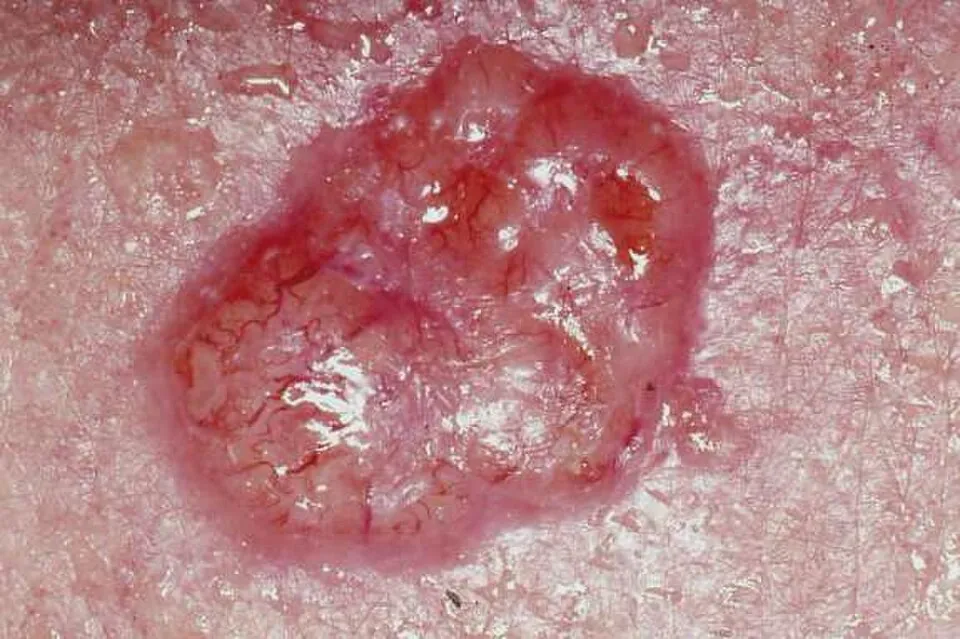
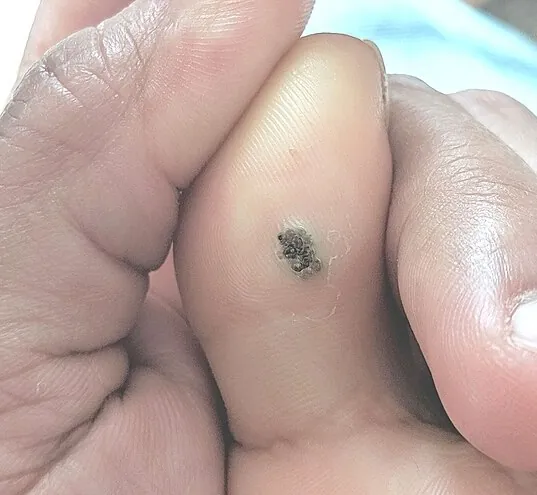
A pearly bump with fine vessels over it, a rough scaly patch, a firm pink lump, or a spot with more than one colour in it. The border is often ragged.
Size
Most are the size of a pinhead. They reach their size and then stop.
Growth is the point. Some take years. Some take weeks.
Does it change
New ones appear elsewhere over the years, but each individual spot holds still.
Changing size, changing colour, changing shape, or a new part budding out of one side.
Does it bleed
A razor or a fingernail can catch one, and it bleeds a lot for its size. It then settles and does not do it again.
It bleeds, scabs, looks healed, then bleeds again in the same place. That repeating cycle is the most common way a skin cancer gets found.
Where it shows up
The torso first, then the upper arms, shoulders and neck. The face is less usual.
Face, nose, ears, scalp, lips, neck, forearms and the backs of the hands. Melanoma can also appear on skin that rarely sees sun.
When it needs a doctor
A red dot you have had for years needs nothing. One you cannot place, or one that has changed, is worth showing someone.
A spot that grows, bleeds without being knocked, or has not healed in about four weeks should be looked at by a dermatologist. Most turn out to be harmless. Checking takes minutes, and these are far easier to treat small.
The colour is the most useful clue
A cherry angioma is one colour: Bright cherry red or a deep purple-red, the same shade from edge to edge, with a clean round border. It looks like a drop of red paint sitting on the skin.
A worrying spot is rarely one clean colour: Amelanotic melanoma is a melanoma with little or no brown pigment in it. It tends to be a dull pink or red rather than a vivid one, and the shade varies across it. Basal cell carcinoma looks translucent or waxy rather than solid red, often with fine threadlike vessels running over the surface.
Red spots that are neither
Pyogenic granuloma: A fast-growing red lump that bleeds heavily and is hard to stop. It is benign, but it grows over weeks, so it always gets checked.
Angiokeratoma: A dark red or almost black spot with a rough, slightly scaly top. Common on the thighs, lower legs and scrotum.
Spider angioma: A small red dot with fine threads running out from it. Press the centre and the whole thing empties, then fills back in from the middle.
Petechiae: Flat pinpoint red dots that appear in a crop after straining or pressure. They fade over days.
Why cherry angiomas keep appearing
Age is the main reason: About half of adults have at least one after the age of 30, and by 75 most people have several. They also run in families.
Getting more of them is normal: A scatter of new red dots across the torso over a few years is the usual pattern, and the number is not a warning sign. What matters is whether any one of them is behaving differently from the rest.
Having one removed
Cherry angiomas do not need treating: They are removed for cosmetic reasons, or when one sits where a razor or a waistband keeps catching it.
Removal is quick: A dermatologist can use a vascular laser, gentle heat, or a small scrape. It takes seconds per spot and leaves a mark that fades. Removing one does not stop new ones forming.