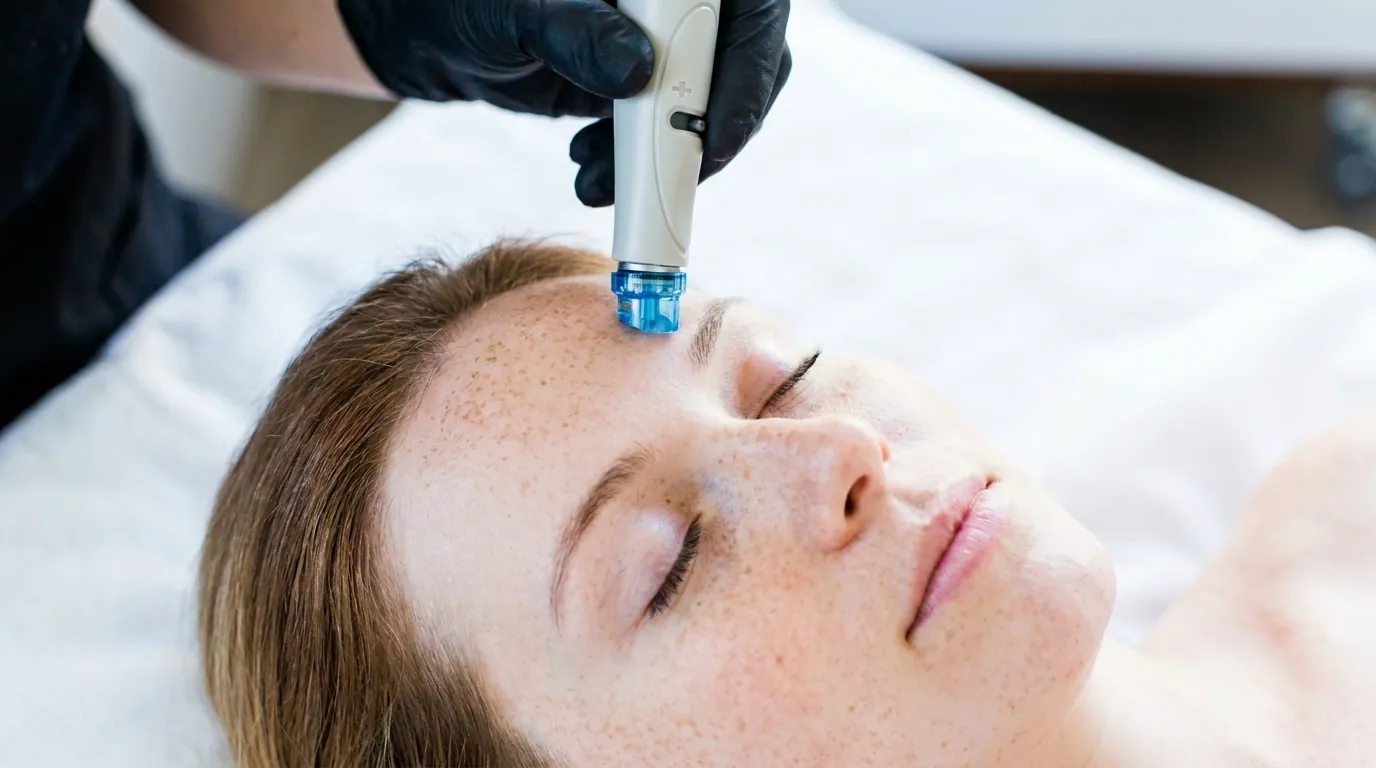
HydraFacial vs Regular Facial
A HydraFacial is one machine doing the same few things every time, in about half an hour. It exfoliates, clears pores with suction and delivers a serum, and you get much the same treatment wherever you book it. A regular facial is a person deciding what your skin needs that day, usually over an hour. The machine is better for congestion and for a predictable result; a good facial is better for dry, tight or easily irritated skin.
What it is
Fluid is pumped to the tip while suction pulls it back, so the same pass exfoliates, delivers a solution and empties pores. It runs about 30 minutes.
Cleanse, steam, exfoliate, extract by hand, mask, massage, moisturise. The steps and products are chosen by the therapist.
Who makes the decisions
The tip and the suction level are chosen for you, but the sequence is fixed. That is the point of it.
Everything is a judgement call, which is why the same treatment name gives very different results in different hands.
How long it takes
Short enough to fit into a lunch break.
Much of that is massage, mask time and unhurried extraction.
What it is best at
The suction empties pores efficiently, and the result is visible the same day.
Dry, tight or reactive skin that does not tolerate acids and suction well often does better here.
What it feels like
Not painful, but not relaxing either. Skin is a little pink for an hour or two.
Extraction is the uncomfortable part, and it can leave small red marks where pores were worked on.
How long the result lasts
Clinics generally recommend monthly, which suits a membership model as much as it suits your skin.
The same. Monthly is a convention based on skin turnover, not a tested schedule.
How consistent it is
The machine, the tips and the steps are standard, so you can book it anywhere and know roughly what you get.
There is no standard definition of a facial. The therapist is the variable, and it is a big one.
Cost
The platform, single-use tips and serums are built into the price.
A 90-minute facial at a good spa can cost more than a HydraFacial. A short one costs much less.
The at-home or drugstore version
Home pore vacuums have no serum system and far weaker suction. Same idea, much less of it.
Cleanse, a gentle exfoliant, a mask and a moisturiser is the same sequence. What you cannot copy at home is skilled extraction.
Who each suits
What the machine actually adds
It adds consistency: The tip abrades to a set roughness and the suction pulls at a set pressure, so the treatment is much the same each time and in each clinic.
It adds efficient extraction: Suction empties clogged pores faster and with less pressing than a pair of hands, which is why congested skin tends to prefer it.
It adds a delivery step at the right moment: A mild acid solution goes onto the surface just as it is scuffed. A split-face study found acid applied with suction cleared whiteheads and blackheads better than the same acid applied alone.
What a good facial has that a machine does not
It has judgement: A therapist can spend twenty minutes on one blocked area, skip exfoliation on a day your skin is irritated, or swap a mask when your cheeks flush.
It has gentleness as an option: Skin with rosacea or eczema often does badly with abrasion and suction. Hands, steam and hydration are a better fit, and no machine setting replaces that choice.
It has the parts nobody measures but everyone notices: Massage, warmth and an hour lying still are a real part of what people buy, and it is fair to say so.
What neither one does
Neither one treats acne: Both make skin look better on the day. The major dermatology guidelines do not recommend facials or blackhead extraction as acne treatment.
Neither one changes skin structure: No study has shown a lasting change in collagen from either. What you are buying in both cases is short-term surface improvement.
Neither one has been properly studied: A plain facial has never been used as a comparison group in a published trial, and the HydraFacial literature is a handful of small papers.
Before you book
If you want extraction, say so, and ask how long is spent on it.
Say if your skin is reactive, or if you have rosacea or eczema. Suction and acids are the steps most likely to cause a flare.
Say if you scar or darken easily after spots. Over-extraction is the main way either treatment goes wrong.
Pause retinoids and strong acids for a few days beforehand.
Ask for the step list and the products used. A good clinic answers that easily.