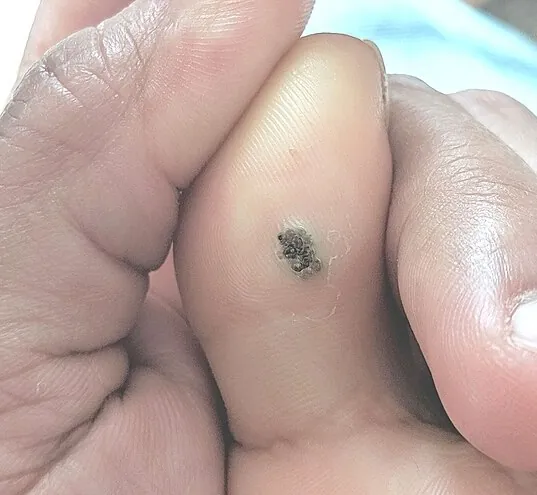
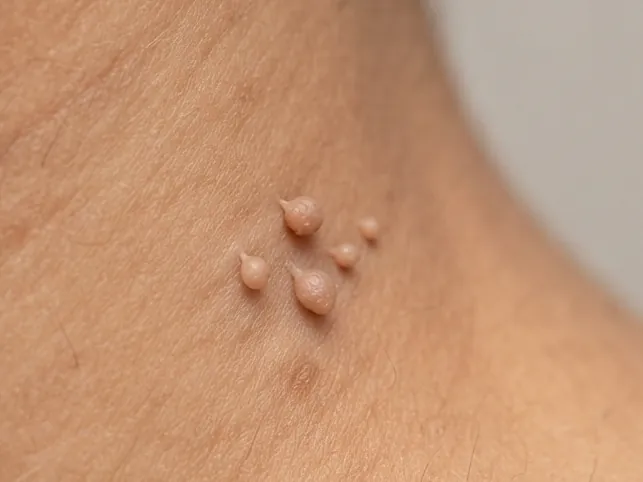
Milia vs Skin Tag
Milia are tiny keratin cysts trapped just under the surface of the skin. They are firm, white or pale yellow, and they do not move when you push them. Skin tags are soft flaps of skin growing on a thin stalk. They are flesh-coloured, and they wobble when you touch them. White and hard means milia. Soft and dangling means a skin tag.
What it is
Keratin is the protein that makes up the surface of your skin. A small amount gets trapped in a closed pocket under the skin, and there is no opening for it to come out of.
A loose bundle of collagen and blood vessels wrapped in skin. It grows outward on a narrow neck, usually where skin rubs against skin.
What it looks like
Smooth, round and dome-shaped. There is no opening on top and no redness around it. It looks like a grain of sand sitting under the skin.
Skin-coloured or a shade darker. The surface can be smooth or slightly wrinkled. It hangs off the skin, so it moves when you brush past it.
Size
About the size of a pinhead. Milia stay the size they started at.
Usually the size of a grain of rice. A few keep growing over years and reach a centimetre or more.
Does it itch or hurt
Milia are painless and do not itch. People notice them by sight, usually in the mirror in good light.
A tag is painless on its own. It can sting or bleed if a necklace, a collar, a seatbelt or a razor catches it.
Where it shows up
Eyelids and under the eyes most of all, then the nose, cheeks and forehead. Newborns get them across the nose and chin.
Neck, armpits, groin, under the breasts, and the eyelids. Anywhere skin rubs on skin or on clothing.
Does it spread
Not contagious. Several can appear in one small area, but one does not seed the next.
Not contagious either. People who get one usually get more in the same folds, because the cause is friction rather than a germ.
What it does over time
Milia in babies clear within a few weeks. In adults they often sit quietly for months, and some stay for years.
A skin tag does not go away by itself. Occasionally one twists on its stalk, turns dark and drops off, but that is uncommon.
How it is treated
A clinician opens the surface with a sterile needle and lifts the keratin out. It takes seconds per bump, usually needs no anaesthetic, and the skin heals over within about a week. A retinoid cream can clear a crop slowly instead.
The area is numbed, then the tag is cut at the base with sterile scissors, frozen with liquid nitrogen, or removed with heat. It is over in a minute or two.
Cost
A short cosmetic appointment. Several milia are usually done in one sitting.
Quick to remove, and usually counted as cosmetic, so it is often paid out of pocket.
The wobble test settles it in a second
Push the bump gently sideways with a clean fingertip: A skin tag moves. It is held on by a thin neck, so it swings and folds over. Milia do not move at all. They sit inside the skin, so the skin slides and the bump travels with it.
Then look at the colour: Milia are white or pale yellow, because trapped keratin is white. Skin tags are the colour of the skin around them, or slightly darker.
Can you pick milia off yourself?
No, and trying is the most common way people mark their own eyelid: A milium has no opening. Squeezing pushes it against intact skin, so nothing comes out however hard you press. What does come out is blood, and what is left behind is a brown mark or a small dent.
The skin on the eyelid is the thinnest on the body: A needle held at the wrong angle there goes deeper than you meant it to. This is a two-minute procedure for someone who does it every week, and it is worth handing over.
A retinoid cream is the sensible home option: It speeds up how fast the surface layer sheds, which helps trapped keratin work its way out. It takes weeks to months, not one evening.
Do not tie off or cut a skin tag either
Home removal kits work by strangling the stalk or burning the base: The usual results are bleeding, an infection, and a mark that lasts longer than the tag would have.
The larger problem is the diagnosis: Several things look like a skin tag and are not: a mole on a stalk, a wart, a small cyst, and rarely a skin cancer. Cutting it off at home destroys the thing a doctor would have wanted to look at.
See a doctor if
The bump has changed colour, size or shape
It bleeds without being knocked
A skin tag has turned dark, painful or swollen
White bumps have appeared in a patch on scarred or blistered skin
Milia are still there after three months
You are not certain which one you have