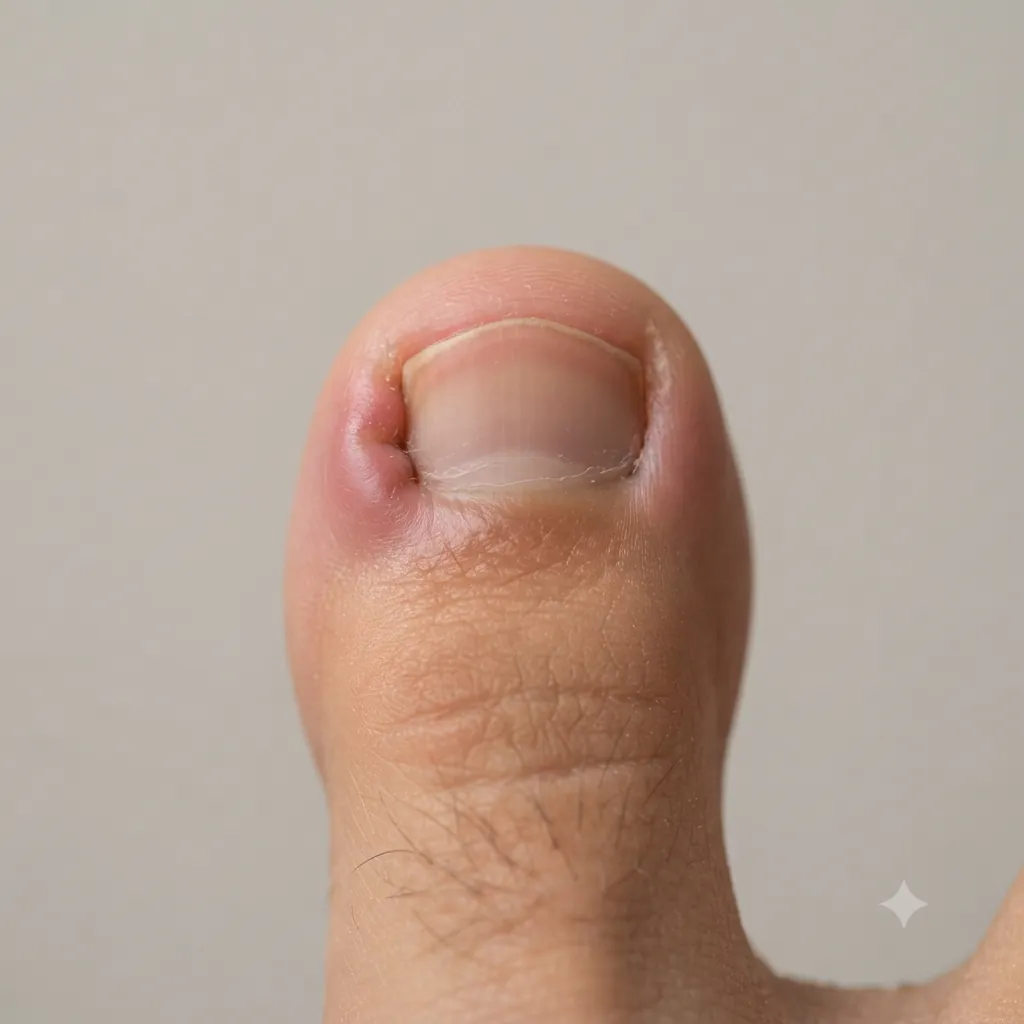
Normal Toenail vs Ingrown Toenail
A normal toenail ends in a straight free edge that sits on top of the skin. You can see the whole corner of the nail, and the skin beside it is the same colour as the rest of your toe. An ingrown toenail has a corner that has disappeared into the skin fold. That side gets tender first, then red and puffy. If you can see the corner of your nail, it is not ingrown yet.
What it is
The nail plate slides forward over the nail bed and its free edge overhangs the tip of the toe. The skin folds at the sides sit alongside the nail, not on top of it.
The corner of the nail is angled down into the soft skin fold at the side. The body treats it like a splinter and swells around it.
What the edge looks like
A clean straight line at the tip, with both corners clear of the skin. A little natural curve across the nail is normal.
The nail edge vanishes into the skin partway along. The fold may bulge up over it and look shiny.
What the skin beside it looks like
Flat, dry and unremarkable. No swelling and no shine.
Swollen on one side. Later there may be a bead of yellow fluid, or soft pink tissue growing up over the nail edge.
Does it hurt
You should not be aware of a healthy nail at all.
Tender first, then sore in shoes, then throbbing. Pressing that one corner reproduces the pain exactly.
What it does over time
A toenail takes roughly twelve to eighteen months to replace itself completely. Ridges along its length and slight thickening with age are normal.
It will not settle on its own while the nail is still digging in. Left alone, the skin piles up over the edge and can start to weep.
How it is treated
Trim after a shower when the nail is softer. Go straight across, no shorter than the tip of the toe, and leave the corners alone.
Soak in warm salt water for ten to fifteen minutes a few times a day, wear open or roomy shoes, and have a clinician lift or trim the corner if it does not settle. A stubborn one is treated by numbing the toe and removing a narrow strip of nail edge.
The cutting habit that causes most of them
Rounding the corners is what starts an ingrown nail: People follow the curve of the toe with the clippers because it looks neater. That leaves the corner shorter than the skin beside it, so the skin closes over the gap. When the nail grows back out, it grows into that skin instead of over it.
Cutting too short does the same thing: If the nail is trimmed behind the tip of the toe, the skin at the end has nothing holding it flat and rides up in front of the nail.
Straight across, level with the toe tip, is the whole rule: Use nail clippers rather than scissors, and take several small cuts instead of one big one. If a corner feels sharp, file it smooth rather than cutting it back.
Catching it early
The first sign is tenderness in one corner, with nothing to see: Press along both sides of the nail. A healthy nail feels the same on both sides. An early ingrown nail is sore on one side and normal on the other.
At that stage soaking and roomy shoes usually fix it: Ten to fifteen minutes in warm salt water softens the skin fold enough for the nail to lift clear. Swap tight shoes for something open for a week.
Once there is pus or overgrown tissue, home care has been outrun: Removing a narrow strip of the nail edge under local anaesthetic takes a few minutes and relieves the pain the same day.
Things that look wrong but are normal
Lengthwise ridges, which become more obvious with age
A big toenail that is thicker than the others
A small white mark after a knock
A nail that curves gently across its width, as long as the corners stay clear of the skin
See a doctor if
Pus, spreading redness, or heat around the toe
Soft pink tissue growing up over the nail edge
Pain that changes how you walk
The same toe goes ingrown again and again
One nail alone is dark, streaked, or changing shape
You have diabetes, neuropathy, or poor circulation — do not treat a toe at home