Psoriasis vs Eczema
Both are long-term skin conditions that cause red, scaly patches. They are not the same thing, and they are not treated the same way.
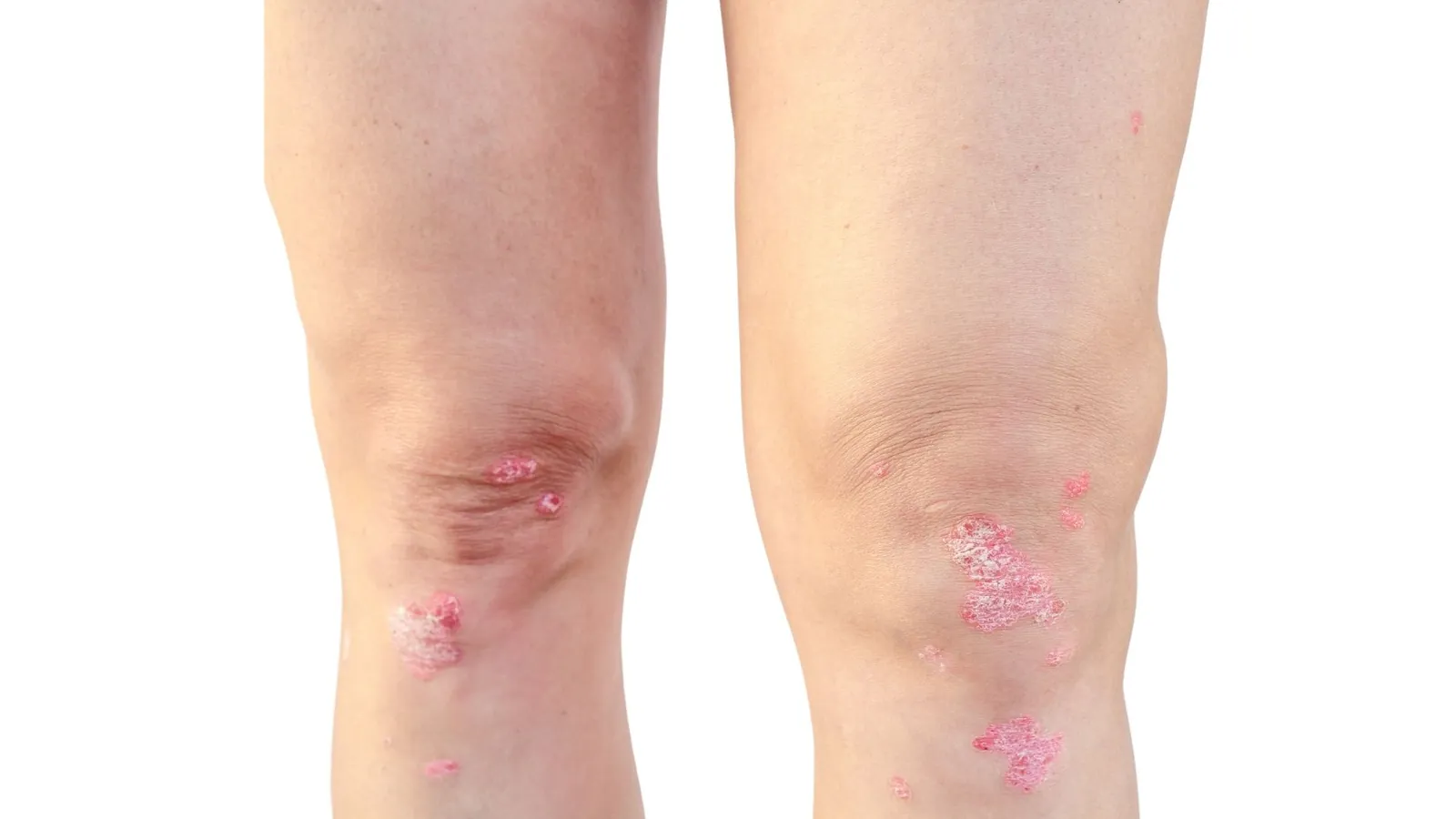
The fastest clue is where it shows up. Psoriasis likes the outside of joints — the outside of your elbows, the front of your knees, your scalp, your lower back. Eczema likes the inside — the crease inside your elbow, behind your knee, your neck, your hands.
The second clue is the itch. Eczema itches so much it wakes people up. Psoriasis itches too, but people more often call it burning, stinging, or sore.
What is happening in the skin
Your skin does not hold water well, so it dries out, cracks, and reacts to things that would not bother other people.
Your immune system speeds up skin cell production. The extra cells pile up on the surface as thick scale.
Where it shows up
Inside the elbow, behind the knee, the neck, the hands, the eyelids. In babies, the cheeks and the outside of the arms and legs.
Outside the elbow, front of the knee, the scalp, the lower back, the belly button.
What the patch looks like
The patch fades into normal skin. It may weep clear fluid, crust over, or look cracked and raw from scratching.
You can trace the border with a finger. The patch is thicker, and it is topped with dry silver-white scale.
How it feels
Often the worst at night. Scratching makes it spread and thicken.
More often described as burning or stinging. Picking the scale off can leave tiny bleeding dots.
When it usually starts
Most people start before age five. Many grow out of it. It often runs with asthma and hay fever.
A second, smaller wave starts after age fifty. It often runs in the family.
Your nails
Small dents like pinpricks, yellow-brown patches that look like an oil stain, or a nail lifting away from the bed.
Your joints
About 1 in 3 people with psoriasis get joint pain and stiffness from it. Morning stiffness that lasts over 30 minutes is worth mentioning to your doctor.
What helps most
Thick cream or ointment, every day, even on clear skin. Steroid cream for flares. Prescription options for stubborn cases.
Steroid cream plus a vitamin D cream. Light therapy. Injections that target the immune system for widespread cases.
Who tends to have it

Can you have both?
Yes. It is not common, but it happens, and it is one reason people get the wrong diagnosis for years. Some people also have a rash that looks like both at once. Doctors sometimes call this overlap, and it usually needs a small skin sample to sort out.
How a doctor tells them apart
Most of the time, by looking. A dermatologist checks the pattern, the edges of the patch, your nails, your scalp, and your family history.
If it is still unclear, the next step is a punch biopsy — numbing a small spot and taking a piece of skin about the size of a pencil eraser. Under the microscope the two look clearly different. It takes a few minutes and leaves a small mark.
Why the label matters: the strongest treatments are not interchangeable. The injections that clear severe psoriasis do not treat eczema, and the ones for severe eczema do not treat psoriasis. Getting the name right is what unlocks the right option.
What to do while you wait for an appointment
- Moisturize twice a day, every day. Thick cream or ointment, not lotion. This helps both.
- Switch to a gentle, fragrance-free wash.
- Keep showers short and warm, not hot.
- Try not to scratch. Scratching thickens eczema, and injuring skin can trigger a new psoriasis patch.
- Take photos of the rash. It may look different by the time you are seen.
See a doctor sooner if
- The rash covers a large part of your body, or came on fast
- Your skin is hot, swollen, oozing yellow fluid, or crusted with honey-colored scabs — that is an infection
- You have joint pain or stiffness along with the rash
- You are losing sleep, or avoiding things you want to do
- Nothing you have tried from the drugstore has changed it in two weeks