Ultherapy vs Facelift
Ultherapy tightens skin modestly with no surgery and no recovery. It uses focused ultrasound to heat tissue under the skin so it firms over the following months. A facelift lifts and removes skin that has already dropped. It is surgery, with anaesthetic and a real recovery, and the change is far bigger. Ultherapy is not a smaller facelift, and it suits early, mild looseness rather than skin that has clearly descended.
What it is
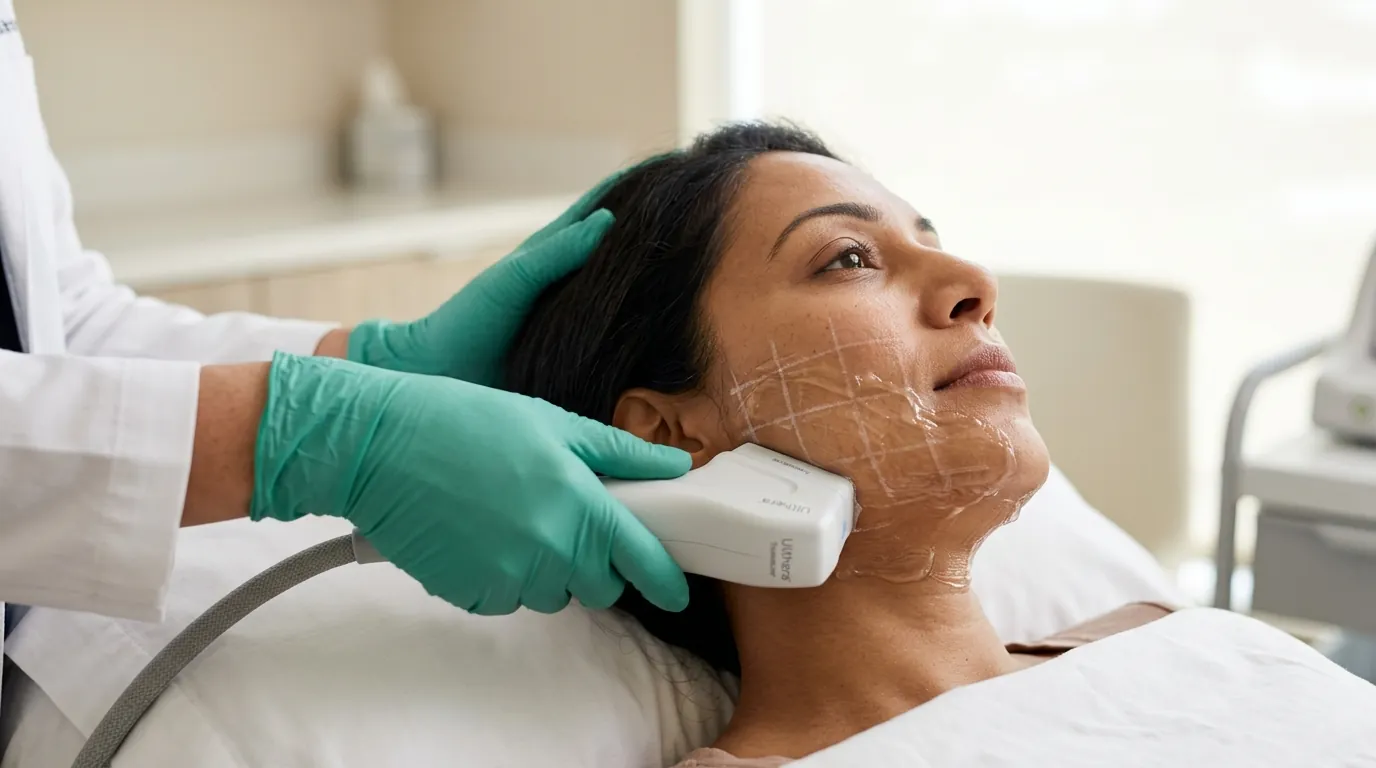
A handpiece delivers heat to set depths below the surface. The heat makes tissue contract and prompts new collagen over the following months.
The surgeon lifts and repositions the tissue beneath the skin, then removes the skin that is now spare. Often paired with a neck lift.
What happens on the day
You lie still while the handpiece passes over the face and neck. It is uncomfortable in short bursts. You leave and carry on with your day.
A surgical suite, general anaesthetic or heavy sedation, and someone to take you home afterwards.
What you will see
Skin looks tighter and the jawline a little cleaner. It is the kind of change you notice in photos rather than one other people comment on.
Jowls, the jawline and the neck are visibly different. It is the largest change available for facial sagging.
How long until you see it
Little happens on the day. Collagen builds slowly, so you judge it at three months, not at three weeks.
The shape is there once the swelling drops. The final result lands around three months.
How long it lasts
Many people repeat it every twelve to eighteen months to hold the effect.
Roughly seven to fifteen years depending on the technique and your skin. It does not stop ageing, it sets you back.
Downtime
Some redness, tenderness and mild swelling for a day or two. You can go back to work straight away.
Bruising and swelling settle over the first fortnight. Most people take two to three weeks before they want to be seen.
What it will not do
There is no spare skin removed and nothing repositioned. If you can lift your jowl with a finger and see the result you want, Ultherapy will not reproduce it.
Surgery moves tissue. It does nothing for texture, pores, sun damage or fine lines, which are treated separately.
The downside
Some people see very little, especially where the looseness was more than mild. There are also reports of unwanted fat loss in the treated area.
Scars, though they are placed in front of and behind the ear. A recovery. A risk profile you go through with a surgeon, and a result you cannot undo.
Cost
Priced per treatment, and usually per area. Because it is repeated every year or two, work out the cost over five years.
Priced as surgery. Ask for a quote that includes the surgeon, the anaesthetist and the facility.
The at-home or drugstore version
Devices sold online use the same words but a fraction of the energy, and they cannot focus it at the depth the clinic device reaches. They warm the surface. That is not the same treatment.
Face tape, gua sha and facial exercises move nothing lastingly. Sagging is a structural change under the skin, and nothing done at the surface repositions it.
Who each suits
The honest way to choose between them
Pull the skin at your jawline gently upward and back with two fingers: If that gives you the face you want, you are describing a facelift. Ultherapy will not reproduce it.
Now look for skin that is slightly soft rather than clearly hanging: That is where Ultherapy earns its place. Early laxity, before there is spare skin to remove.
Age is not the deciding factor, but it tracks closely: People in their thirties and forties are usually in the first group and are often too early for surgery. People in their sixties are usually in the second and are often disappointed by a device.
Ultherapy is not a facelift, and it should not be sold as one
Every honest comparison lands in the same place: Ultherapy gives a modest tightening. A facelift gives a structural change. The gap between them is large and it does not close with more sessions.
Results also vary more with Ultherapy than with surgery: Two people can have the same treatment and get different amounts of firming, because it depends on how much collagen your body makes.
It is still a real treatment: The problem is the marketing that calls it a needle-free facelift, which sets people up to be disappointed.
What each one leaves untouched
A facelift does nothing for skin quality: Texture, pigment and sun damage carry on as before, so most people pair surgery with skincare, a laser or a peel.
Ultherapy does nothing for volume: If your face looks hollow rather than loose, tightening it can make the hollowness more obvious. That is a filler conversation.
Neither one touches lines made by movement: Frown lines and forehead lines come from muscle and are treated with botulinum toxin.
Before you book
Ask to see before-and-after photos of the actual practitioner's own patients, at the same age and looseness as you.
Ask what result they expect for you specifically. "A modest tightening" is an honest answer for Ultherapy and you want to hear it.
If you are considering surgery, ask what the quote includes and who administers the anaesthetic.
Book a surgical consultation even if you plan to try a device first. Knowing what is actually causing the change makes every other decision cheaper.