Dermatologist's Take
Male pattern hair loss is inherited and permanent, but it is treatable — treatment holds the ground you still have far better than it brings back hair you lost years ago. The two proven medicines are minoxidil (as a topical, or as low-dose tablets used off-label) and finasteride, and they work better together than alone. Give either one 6 to 12 months before you judge it, and understand that the gains fade within about a year of stopping, so this is an ongoing commitment. Starting early matters more than anything else you can do, because a follicle that has already shrunk to fuzz is much harder to bring back than one that is only thinning. If your hair is shedding all over the scalp instead of in the classic pattern, or it came out fast over a few weeks, see a dermatologist first — that is probably something else, and several of those causes reverse on their own.
At a glance
- How Common: The most common cause of hair loss in men. More than half of white men have a visible sign of it by age 50.
- Who Gets It: Men with a family history on either side of the family. It can start in the late teens or twenties.
- Chronic or Curable: Chronic. There is no cure. Treatment slows it and can partly reverse recent thinning.
- Rx Required: Partly. Topical minoxidil is over the counter. Finasteride and oral minoxidil need a prescription.
- Harmful? No. It causes no physical harm. The effect on how men feel about themselves is real, though, and worth taking seriously.
What is it?
Male pattern hair loss is the gradual, inherited thinning of scalp hair that follows a predictable shape: the hairline pulls back at the temples, and a thin spot opens at the crown. The medical name is androgenetic alopecia — "andro" for the male hormones involved, "genetic" for the inherited sensitivity that makes those hormones matter.
Here is the framing that makes it click: your hair is not really falling out. It is shrinking. Every hair on your scalp grows for a few years, rests, sheds, and is replaced by a new one from the same follicle. In affected areas, each new hair comes back a little finer, a little shorter, and a little lighter than the one before. Dermatologists call this miniaturization. Repeat that cycle enough times and a thick, dark, three-year hair has become a short, pale, barely visible fuzz. The follicle is still there for a long time. It is just producing less and less hair.
The hormone driving this is DHT (dihydrotestosterone), which your body makes from testosterone using an enzyme called 5-alpha reductase. DHT is not high in men who go bald — the follicles on the top of the scalp are simply more sensitive to it, and that sensitivity is inherited. Follicles on the sides and back of the head are not sensitive, which is why almost no one goes bald there, and why those hairs keep growing even after they are transplanted to the top.
The pace varies a lot. Some men lose their hairline in their twenties and stop. Others thin slowly for thirty years. There is no way to predict your course from your father's, since the genes come from both sides.
What it looks like
- A receding hairline at the temples. The corners move back first, leaving a hairline shaped like an M or a widow's peak. This is usually the earliest sign and often starts in the twenties.
- A thinning patch at the crown. The swirl at the back of the head opens up. Many men never see this themselves and only notice it in a photo or a barber's mirror.
- Hair that is finer rather than gone. Run your fingers along the top of your scalp and compare it to the back. In pattern loss, the hairs on top feel thinner and shorter, and you will see hairs of several different thicknesses mixed together in the same area.
- Scalp showing through under light. Thinning often shows up first in bright overhead light or when hair is wet, before it is obvious dry.
- Modest daily shedding, not clumps. Losing some hair in the shower is normal. Pattern loss is a slow change in density, not a sudden increase in what comes out.
- The sides and back stay full. This is the giveaway. A horseshoe of normal hair around the sides and back with thinning on top is pattern loss and almost nothing else.
How obvious it looks depends partly on contrast. Thinning shows up soonest when dark hair sits over lighter scalp, and is easier to hide when hair and scalp are closer in color. That is a cosmetic point, not a medical one — the underlying process is the same. Men with tightly coiled hair may also have thinning from tight styling on top of pattern loss, and the two need to be told apart because only one of them reverses.
What causes it
Two things have to line up: androgens (male hormones) and inherited sensitivity to them. DHT binds to receptors in the follicles on the top of the scalp and shortens the growing phase of the hair cycle. Instead of growing for three to six years, the hair grows for months. Shorter growing phase means shorter, finer hair, and eventually not much hair at all.
The genetics are not simple. Many genes are involved, they come from both your mother's and your father's side, and no consumer genetic test predicts your outcome reliably. The most useful information is still your own scalp compared to a photo of it from five years ago.
Things that are genuinely associated with pattern hair loss:
- Family history on either side. The single strongest predictor.
- Age. It becomes more common every decade. It rarely improves on its own.
- Anabolic steroids and high-dose testosterone. More androgen in a sensitive scalp speeds things up.
- Smoking. Repeatedly linked to earlier and more severe pattern loss, though the reason is not settled.
- Metabolic conditions. Obesity, insulin resistance, and early heart disease show up more often in men with early severe balding. This is an association, not proof that one causes the other.
What does not cause it, despite what you may have read: wearing hats, washing your hair too often, blow-drying, hair gel, sweating, poor scalp circulation, or clogged follicles. Hair loss is not contagious, is not a sign of poor hygiene, and is not caused by stress alone — stress causes a different, temporary kind of shedding described below.
Triggers
- Stopping treatment. The most common reason men suddenly get worse. Once minoxidil or finasteride stops, the hair it was holding onto is shed over the following months and you land back where you would have been.
- Anabolic steroids, prohormones, and testosterone therapy. These can accelerate pattern loss noticeably in a sensitive scalp. If you are on testosterone for a medical reason, this is worth raising with the prescriber rather than stopping on your own.
- A separate shedding episode stacked on top. Illness, surgery, rapid weight loss, or a very low-calorie diet can cause a temporary all-over shed. In a man who already has pattern loss, that shed unmasks the thinning and it looks like sudden balding. It usually recovers, but the pattern loss underneath does not.
- Tight styling. Man buns, tight braids, and tight ponytails pull on the hairline and cause a separate, mechanical hair loss that can become permanent if it goes on for years.
- Aggressive scalp treatments. Harsh chemical relaxers, frequent bleaching, and high-heat tools damage the hair shaft. They do not cause pattern loss, but they make thin hair break and look worse.
- Delay. Not a trigger exactly, but the biggest avoidable factor. Every year of untreated loss is follicles moving further down a road that treatment cannot fully walk back.
Treatment Overview
Everyone with this condition
Keep in mind
At-Home Treatment
It helps to think of treatment as doing three separate jobs. Most men who are unhappy with their results are doing one job and expecting all three.
Job one: slow the shrinking. This means blocking DHT, which is what finasteride does. It is a prescription pill, covered in the Prescription section below. Nothing you can buy over the counter does this job in a proven way.
Job two: push the follicles to grow. This is minoxidil. It lengthens the growing phase and thickens the hairs that are still there. Topical minoxidil 5% is over the counter and is the standard starting point. Apply about 1 mL of solution, or half a capful of foam, to a dry scalp — to the skin, not the hair — once or twice daily. Foam dries faster and is much easier to live with if you have short hair; the liquid solution spreads better through longer hair but contains propylene glycol, which is the usual reason for an itchy, flaky scalp.
Job three: stop making it worse. Loosen tight hairstyles. Treat dandruff, since an inflamed scalp is a worse environment for hair and also makes minoxidil sting. Deal with anything that could be causing a separate shed — crash dieting, an untreated thyroid problem, low iron. None of this regrows hair by itself, but it stops you fighting on two fronts.
Two things to expect that catch people out. First, minoxidil often causes a shed in the first two to eight weeks, where resting hairs are pushed out to make way for new ones. It looks like the drug is making things worse. It is not, and it settles. Second, the honest timeline is 6 to 12 months. Nothing meaningful can be judged at three months. Take a photo of the top of your head under the same light on day one, and another at month six and month twelve — the change is too gradual to see in the mirror.
Set the expectation now: the realistic outcome is holding steady with a modest thickening. Full restoration of a hairline you lost a decade ago is not on the table from any medication.
Prescription treatments

Finasteride 1 mg daily. The most effective single medication for male pattern hair loss. It blocks the enzyme that makes DHT, cutting scalp DHT substantially, which slows or stops the miniaturization. In the five-year trial data, men on finasteride were far less likely than men on placebo to have visible further loss — a 93% reduction in that likelihood — and the AAD puts the proportion of men whose loss is slowed at roughly 80 to 90%. Some men regrow visible hair, most commonly at the crown; the hairline responds less. Expect about six months before results are assessable.
The side effects deserve a straight answer, because this is genuinely contested. In the manufacturer's 12-month trials, sexual side effects were uncommon and only slightly more common than placebo: decreased libido in 1.8% versus 1.3%, erectile dysfunction in 1.3% versus 0.7%, and ejaculation problems in 1.2% versus 0.7%. In those trials the effects resolved when men stopped, and in many who continued. Separately, a large multi-year prostate cancer prevention trial in over 17,000 men found no cases of persistent sexual dysfunction or depression. Set against that, a real number of men report symptoms — sexual, mood-related, and cognitive — that they say continued after stopping the drug. This is sometimes called post-finasteride syndrome, and it now appears on the drug label as a postmarketing report. The studies supporting it are surveys and case series without control groups, drawn from men who sought help because they had symptoms, which makes it impossible to tell from them how often it actually happens. So the honest summary is: the trial data say the risk is small and reversible, the reports of persistent effects are real reports from real people, and nobody has yet run the study that settles how often they represent a drug effect. If you take it, mood changes and sexual side effects are worth watching for and worth stopping over. Finasteride also lowers PSA readings, which matters if you are being screened for prostate problems — tell whoever orders that test.
Dutasteride 0.5 mg. A stronger DHT blocker, used off-label for hair in the US and approved for it in some other countries. Head-to-head studies favor it over finasteride for regrowth. It stays in the body far longer and the same side-effect questions apply, so it is usually a second step after finasteride rather than a starting point.
Low-dose oral minoxidil. Minoxidil in tablet form, typically 2.5 to 5 mg daily in men, used off-label and now very widely prescribed by dermatologists. It solves the biggest practical problem with topical minoxidil, which is that a lot of men will not apply a liquid to their scalp twice a day for years. A multicenter safety review of over 1,400 patients found adverse effects in about a fifth of them, and the great majority of those were unwanted hair growth elsewhere on the body — face, arms, back — at about 15%. Genuinely worrying effects were rare: lightheadedness in under 2%, fluid retention and fast heartbeat in about 1%, and only about 1% stopping because of a whole-body side effect. It lowers blood pressure a little, so it needs a prescriber who knows your heart history. Dose is usually started low and increased slowly.
Topical finasteride. A newer option, applied to the scalp instead of swallowed, designed to hit the follicle with less drug in the bloodstream. Early trial data are encouraging and it does raise blood DHT less than the pill. It is not a zero-systemic-absorption product, so it is a reasonable compromise rather than a way to get the benefit with none of the risk. Availability in the US is mostly through compounding pharmacies and telehealth services.
Combination is the norm, not the exception. Finasteride plus minoxidil outperforms either alone in the studies that have compared them, because the two do different jobs.
In-office procedures
Hair transplant. The only treatment that puts hair where there is currently none. Follicles from the sides and back — the areas that are not DHT-sensitive — are moved to the thinning areas, and because they keep their original programming, they keep growing. Results take up to a year and can look completely natural in the right hands.
The honest caveat: a transplant redistributes the hair you have. It does not create new hair, and it does not stop the loss that is still happening. That means two things. First, your donor area is finite, and a surgeon who takes too much from it leaves you with a thin back and sides. Second, if you do not stay on medication, the untransplanted hair around your new grafts keeps thinning, and a few years later you have an island of dense hair sitting in a thin field. This is the most common way transplants go wrong, and it is why most good surgeons want you stable on treatment first and want to see how your loss is progressing before operating. It is expensive and is not covered by insurance.
Platelet-rich plasma (PRP). Your own blood is spun down and the platelet-rich portion is injected into the scalp, usually monthly for three months and then every few months. The idea is that growth factors in the platelets stimulate the follicle. Results in studies are positive but the studies are small and the preparation methods differ so much between clinics that it is hard to know what you are actually buying. Reasonable as an add-on if medication alone has not been enough, not as a replacement for it, and it needs ongoing maintenance sessions.
Low-level laser and red light devices. Caps, combs, and helmets that shine red light on the scalp. Several are FDA-cleared, which is a lower bar than FDA approval and means the device was judged similar enough to an existing one, not proven effective in the way a drug is. Trials do show a modest benefit. It is painless and low-risk, and it is a fair option for men who cannot or will not take medication — just expect a small effect for a meaningful upfront cost.
Microneedling. Rolling or stamping fine needles into the scalp, usually combined with minoxidil. The small studies that exist suggest it improves minoxidil's results. Doing it at home carries a real risk of infection and scarring if the device is not clean or the technique is too aggressive.
Scalp micropigmentation. Tattooed dots that mimic the look of shaved stubble. It changes nothing biologically, but it can dramatically reduce the contrast between scalp and hair, and it suits men who plan to keep their hair very short. It fades over years and needs touch-ups.


Look-Alikes
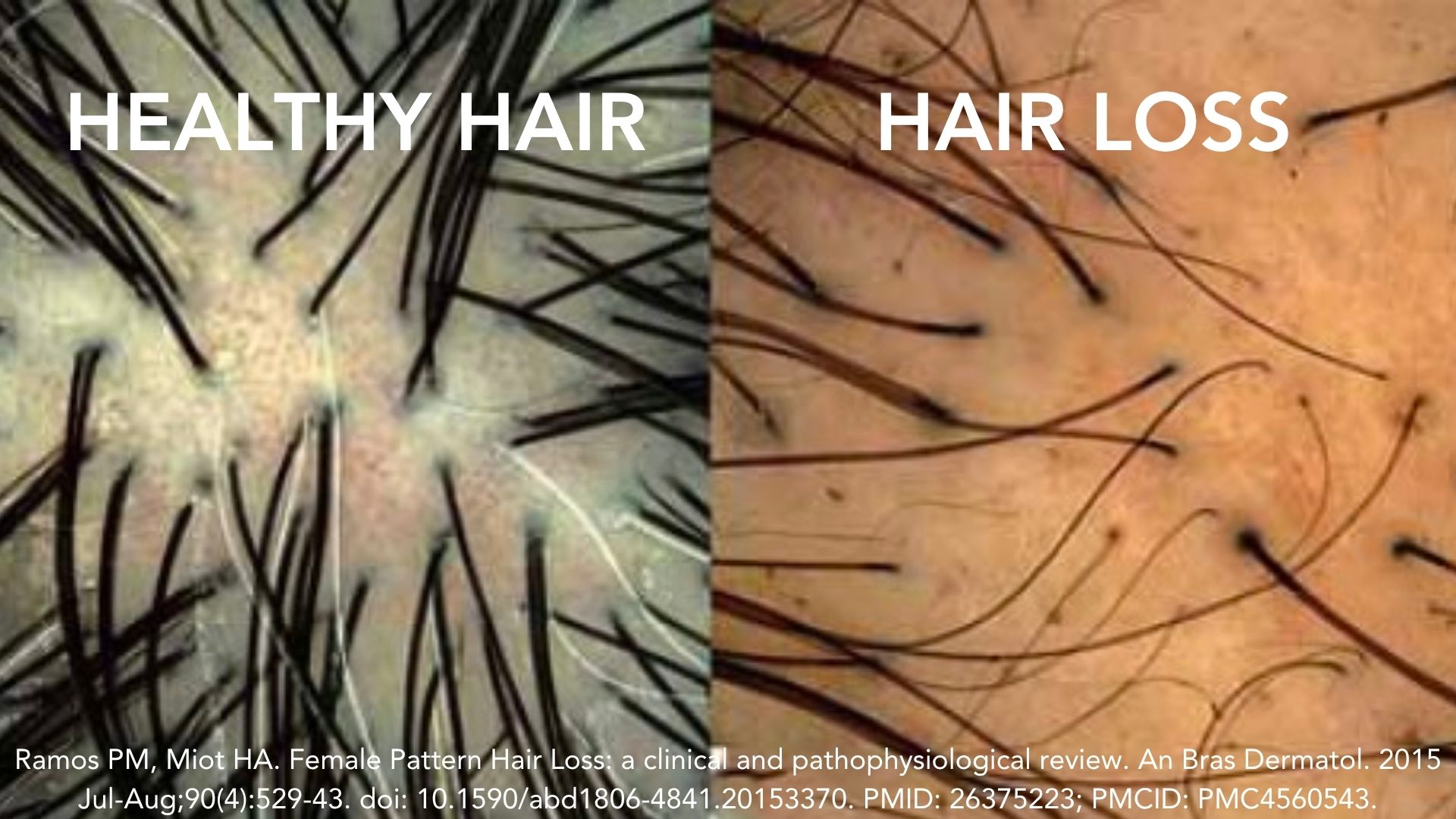
This is the part worth reading carefully, because several conditions that look like balding are treatable or reversible — and one of them causes permanent damage if it is missed.
- Telogen effluvium. A temporary, all-over shed that starts two to three months after a trigger: a serious illness, a high fever, surgery, a crash diet, major weight loss, a new medication, or a period of severe stress. The tell is the pattern and the pace. This comes out everywhere, including the sides and back, in obvious amounts, over a few weeks. Pattern loss is slow and spares the sides and back. Telogen effluvium usually recovers fully within six to nine months once the trigger is gone. It is also the most common reason a man thinks his pattern loss suddenly got dramatically worse — the two often happen at once.
- Alopecia areata. An autoimmune condition where the immune system attacks the follicles. It causes smooth, round, completely bald patches with sharply defined edges — not thinning, but bare skin. It can appear anywhere, including the beard and eyebrows, and it can happen in a matter of weeks. Hair often regrows on its own, and there are effective treatments including newer oral medications. A round bald spot with a clean edge is not male pattern hair loss.
- Traction alopecia. Hair loss from sustained pulling: tight braids, cornrows, dreadlocks, man buns, tight ponytails, or a hairpiece clipped to the same spot. It shows up right where the tension is, most often along the hairline and above the ears, and it can look exactly like a receding hairline. Small pustules or tenderness in the area point toward traction. It is fully reversible early. If the pulling continues for years the follicles scar and it becomes permanent, which is why catching this one early matters so much.
- Scarring alopecias. A group including lichen planopilaris, frontal fibrosing alopecia, and central centrifugal cicatricial alopecia. Inflammation destroys the follicle and replaces it with scar tissue, so the hair does not come back. The warning signs are symptoms — burning, itching, tenderness, or pain in the scalp — plus smooth shiny skin where the follicle openings have disappeared, redness or scale right at the base of the hairs, and loss that does not follow the usual pattern. Pattern hair loss does not hurt and does not itch. Any hair loss with scalp symptoms needs to be seen promptly, because treatment can only stop further damage, not repair what is gone.
- Seborrheic dermatitis and scalp psoriasis. These cause flaking, redness, and itch, and the scratching that comes with them causes breakage and some shedding. They do not cause pattern balding, but they often sit alongside it and make everything look worse. Treating the scalp is worth doing on its own merits.
- Thyroid disease, iron deficiency, and other medical causes. An underactive or overactive thyroid, low iron, and some medications cause diffuse thinning that is easy to mistake for early pattern loss. These are found with a blood test and are treatable, which is a good reason to get diffuse thinning checked rather than assuming.
The single distinguishing feature of male pattern hair loss: it follows the pattern. Temples and crown thin, the horseshoe of hair around the sides and back stays normal, the scalp itself looks and feels healthy, and the change happens over years rather than weeks.