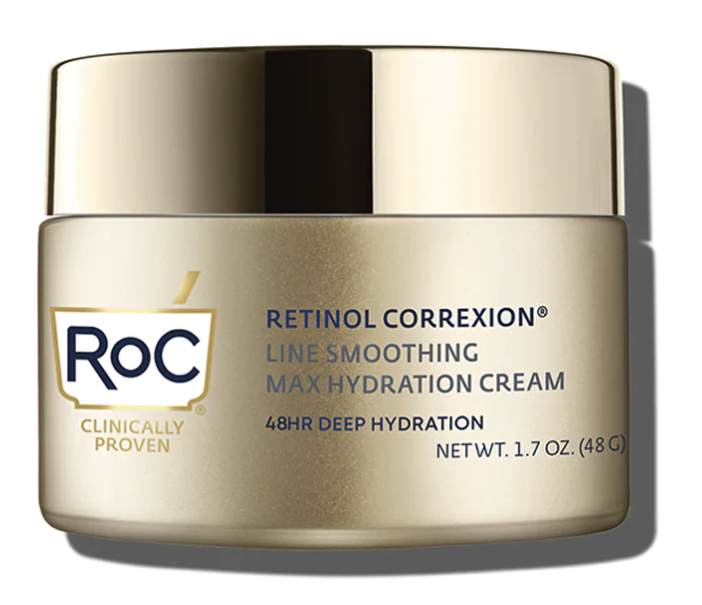
At a glance
Texture — Rich, hydrating cream
Key Active — Retinol (percentage not disclosed)
Best For — Dry skin on a retinoid
Price Tier — $$
What stands out
The hydrating base is a genuinely sensible idea. Retinoids dry skin out and compromise the barrier, and that is the single biggest reason people quit them. Pairing the retinoid with a richer moisturizer directly addresses the thing that makes people stop.
It contains real retinol, not an ester.
A fragrance-free version exists.
Under $30, and easy to find.
Irritation is expected, not a sign it is "working." Redness, flaking and stinging in the first weeks are common with any real retinoid. Start twice a week and build up. If it is still angry after a few weeks, the dose is too high for you.
Watch out for
Same problem as the rest of the line: RoC will not tell you the strength. "Clinical Retinol" is a marketing phrase, not a dose. You cannot compare this to anything, and you cannot know whether you are getting more or less than the Deep Wrinkle cream next to it on the shelf.
It is in a screw-top jar with no inner seal — the worst packaging for a molecule that degrades in air and light.
The standard version contains fragrance. Get the fragrance-free one.
The Correxion naming is genuinely confusing. Max Hydration, Deep Wrinkle, Line Smoothing — different products, all called Retinol Correxion, none disclosing a dose. You cannot tell them apart on the thing that matters.
Pregnancy — the accurate version, because this gets badly misreported.
Oral isotretinoin causes serious birth defects. That is not in dispute, and it is why it is so tightly controlled.
Topical retinoids are a different exposure. Very little gets into the bloodstream. A meta-analysis of 654 pregnancies exposed in the first trimester found no significant increase in birth defects, miscarriage or stillbirth, and a large four-country cohort study since has agreed.
But those studies are not powerful enough to prove safety — so dermatology guidelines still advise using a non-retinoid option while pregnant, as a precaution. Tazarotene is contraindicated outright.
If you used a retinoid before you knew you were pregnant, the evidence is reassuring. That is not a reason to panic. Stop, and talk to your doctor.
Key ingredients
💧 Hyaluronic Acid — hydrates
💧 Glycerin — attracts moisture
🥕 Retinol — anti-aging
Full ingredient list
Formulation Notes
The idea behind this product is right, and worth stating separately from the criticism: the moisturizer you pair with a retinoid is not an afterthought.
Retinoid irritation is mostly barrier disruption, and barrier disruption is what a good moisturizer fixes. Building the two into one step is a sensible answer to the main reason retinoid routines fail.
It is a shame the execution puts it in a jar and hides the dose — because the underlying thinking is sound.