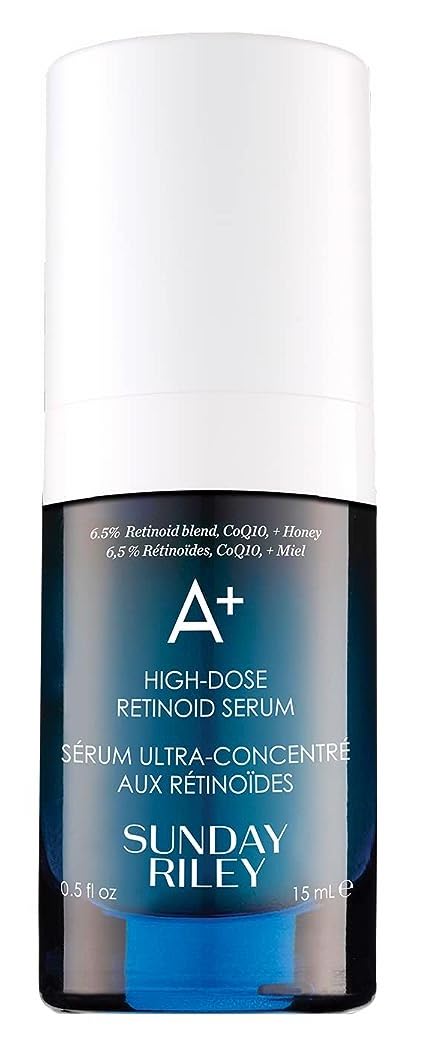
At a glance
Texture — Silicone serum
Key Active — HPR + retinol (true dose undisclosed)
Best For — See below
Price Tier — $$$
What stands out
It is a well-textured serum and people like using it. The silicone base is elegant, and it does not sting the way a genuinely high-dose retinol would.
HPR (hydroxypinacolone retinoate) is a real ingredient, and it is interesting: it appears to bind retinoid receptors directly without needing conversion. In principle that is attractive.
There is nothing dangerous in the bottle.
Irritation is expected, not a sign it is "working." Redness, flaking and stinging in the first weeks are common with any real retinoid. Start twice a week and build up. If it is still angry after a few weeks, the dose is too high for you.
Watch out for
The "6.5% retinoid blend" is the least meaningful number on this page, and here is how it is built:
Roughly 5% is a "retinoid ester complex," 1% is a "liposomal retinol blend," and 0.5% is blue-green algae described as having "retinoid-like activity."
Blue-green algae is not a retinoid. Adding it to a retinoid percentage is not a rounding error — it is a category error. And the two genuine components are themselves complexes, not pure actives: the actual HPR is reported at around 0.5%, and the real retinol is a fraction of that 1% "blend."
So "6.5%" is not a potency figure. It is an addition of things that should not be added. Compare: Drunk Elephant says 1.0% and means 1.0%.
The HPR evidence is thinner than the marketing implies. There is no independent, randomized, matched-dose trial of HPR versus retinol. The claim that it matches retinol's benefits without the irritation is plausible and unproven.
Worth knowing about the brand: Sunday Riley entered into an FTC consent order over employees posting fake reviews of its products on Sephora between 2015 and 2017. That is a fact about how this company markets.
$85, and it contains denatured alcohol.
Pregnancy — the accurate version, because this gets badly misreported.
Oral isotretinoin causes serious birth defects. That is not in dispute, and it is why it is so tightly controlled.
Topical retinoids are a different exposure. Very little gets into the bloodstream. A meta-analysis of 654 pregnancies exposed in the first trimester found no significant increase in birth defects, miscarriage or stillbirth, and a large four-country cohort study since has agreed.
But those studies are not powerful enough to prove safety — so dermatology guidelines still advise using a non-retinoid option while pregnant, as a precaution. Tazarotene is contraindicated outright.
If you used a retinoid before you knew you were pregnant, the evidence is reassuring. That is not a reason to panic. Stop, and talk to your doctor.
Key ingredients
🥕 Retinoid Solution (6.5%) — 5% retinoid ester blend, 1% liposomal-encapsulated retinol, 0.5% blue-green algae retinol alternative
🌿 Hawaiian White Honey — soothes and hydrates
🌿 Bisabolol — calms irritation
⛑️ CoQ10 — antioxidant for skin repair
Full ingredient list
Formulation Notes
"Granactive Retinoid" is a trade name for a solution, not a molecule — and understanding that unlocks a lot of this category.
The raw material is typically only about 10% actual HPR. So a product advertising "2% Granactive Retinoid" contains roughly 0.2% actual HPR.
Almost every HPR percentage you see in marketing refers to the complex, not the active. Sunday Riley's 6.5% is the most extreme version of this on the page, but the trick is everywhere. When you see a big retinoid number, ask what it is a percentage of.