Arbutin vs Hydroquinone
Arbutin is the gentle, buy-it-yourself pigment blocker. It fades dark spots slowly, it rarely irritates, and there is no reason to stop using it. Hydroquinone is the strongest fader most people will ever be offered, and in the United States it needs a prescription. It works faster and goes further, but it is used in courses with an end date rather than kept in the routine.
What it does
Arbutin is a hydroquinone molecule with a sugar attached. Skin enzymes cut that bond slowly, so only a little is released at a time.
It blocks tyrosinase, the enzyme pigment cells use to build melanin. Less new pigment goes into the skin, so the patch fades.
What you do
Smoothed over the whole area rather than dabbed on spots, under moisturizer and sunscreen. It layers with almost anything.
Applied to the patch, usually at night, as part of a plan your dermatologist starts and stops.
What you will see
Sun spots, melasma patches and marks left by old acne gradually stop standing out from the skin around them.
On a stubborn patch it does more than anything sold over the counter, which is why it is still the standard.
How long until it works
How long you use it
There is no stop date. Many people use arbutin as their everyday ingredient and between hydroquinone courses.
It is prescribed as a course. Your dermatologist stops it, often for a couple of months, before deciding whether to run another.
The downside
Occasional stinging or a little redness. The real drawback is that it will not shift a deep, stubborn patch on its own.
Stinging and dryness are common early on. Long unsupervised use can cause a blue-grey staining of the skin called exogenous ochronosis, which is harder to treat than the patch you started with.
Cost
Sold in drugstore and online serums. Price mostly buys the texture of the product and the packaging.
Plain hydroquinone is cheap. Compounded blends and branded combination creams cost considerably more.
The at-home or drugstore version
There is no prescription arbutin. It sits on the shelf on purpose, and it is the same idea as hydroquinone turned right down.
Hydroquinone was pulled from US drugstore shelves. Arbutin, azelaic acid, vitamin C, niacinamide and tranexamic acid are the over-the-counter options, and they do work — more slowly, with less risk. Anything sold openly online as strong hydroquinone is worth being cautious about.
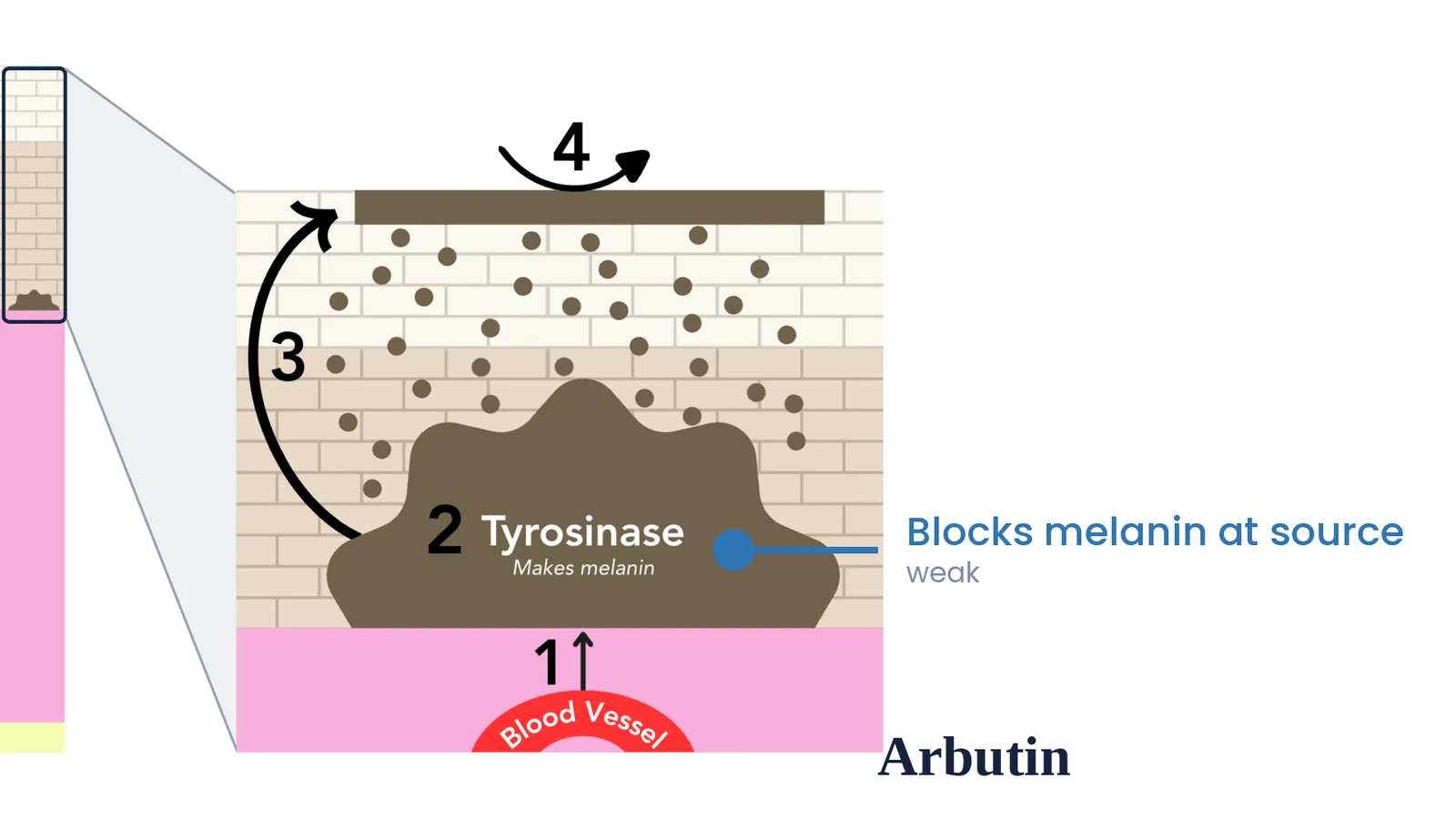
Arbutin is hydroquinone wearing a sugar coat
The two are chemically related, and that is not marketing: Arbutin is hydroquinone bonded to a sugar molecule. Enzymes in the skin break that bond and release a small amount of hydroquinone over time.
The slow release is the whole point: A little pigment blocking, spread across weeks, is why arbutin stings less and why you can keep using it indefinitely.
It is also why it is weaker: Measured side by side, arbutin blocks the pigment enzyme far less strongly than hydroquinone does. On skin that means a gentler result over a longer stretch of time.
Why one comes in courses and the other does not
Hydroquinone has a job with an end point: Once the patch has faded, keeping it on the skin adds risk without adding benefit. So a course runs a few months and then stops.
Arbutin has no end point: It is mild enough to sit in a routine the way niacinamide or vitamin C does, and stopping it simply lets pigment drift back over time.
That difference decides how people combine them: A common plan is a hydroquinone course to clear a stubborn patch, then arbutin and sunscreen to hold the result once the course ends.
Which one to start with
Start with arbutin for mild or moderate marks: Post-acne marks, light sun spots and early melasma respond to it, and you can buy it today without an appointment.
Ask about hydroquinone for a patch that has not moved: Deep melasma and long-standing pigment are what it is for, and a dermatologist watching the course is part of using it well.
Neither one beats new sun exposure: Fading pigment without daily sunscreen is filling a bath with the plug out. The light that made the patch keeps making it.
Before you start either one
Get the patch identified first — melasma, sun spots and post-acne marks do not behave the same way
Take a photo in the same light on day one, because slow fading is hard to judge from memory
Wear broad-spectrum sunscreen every morning, including on grey days
Give either one a full eight to twelve weeks before deciding it has failed
Ask for a stop date with hydroquinone and put it in your calendar
Introduce one new pigment ingredient at a time, not three at once
%2520-%2520Render.webp)