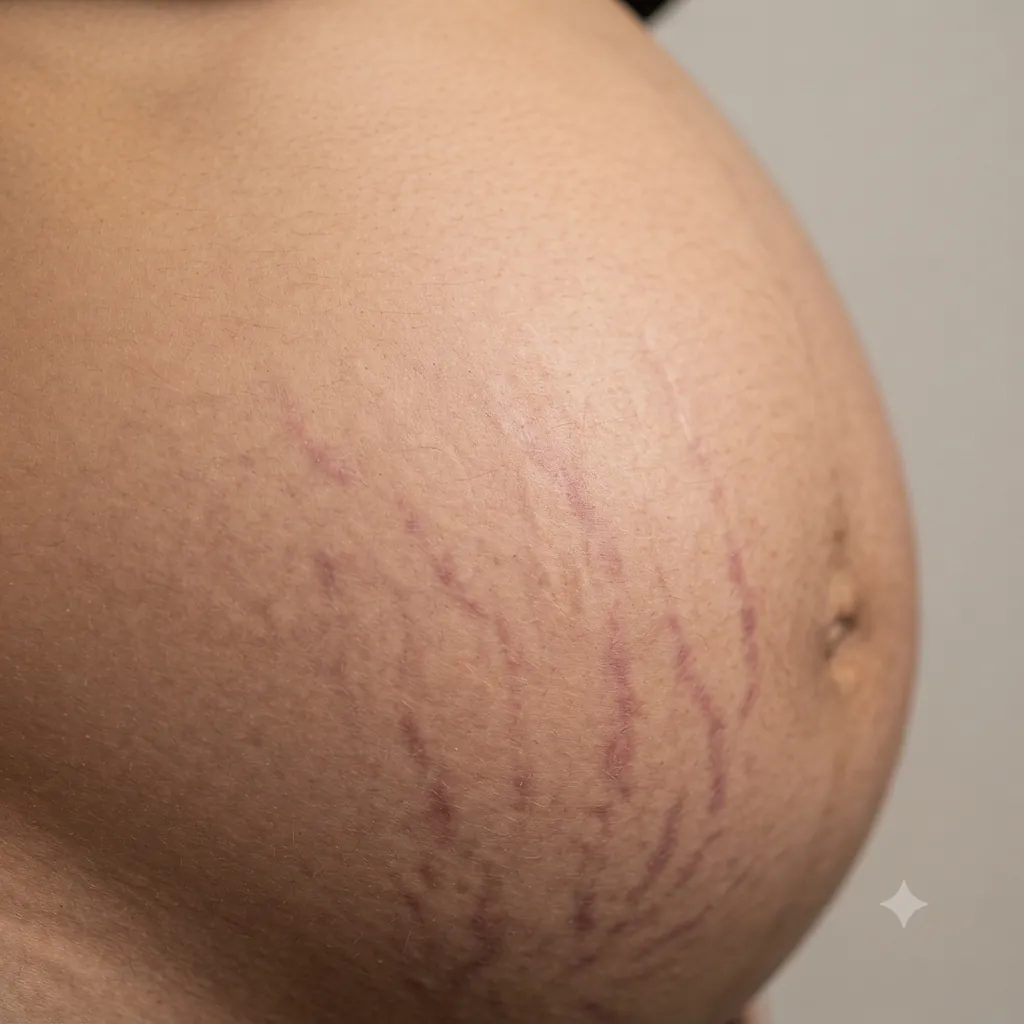
Cellulite vs Stretch Marks
Cellulite is dimpling in the surface of the skin. The skin looks puckered or padded, like the peel of an orange, and pinching the area makes it more obvious. Stretch marks are scars left by skin stretching too fast. They are narrow lines running side by side, red or purple at first and silver later. Dimples means cellulite and lines means stretch marks. Most people who have one also have the other, and neither causes the other.
What it is
Bands of connective tissue run down from the skin to the layer beneath. Fat sits between them. Where a band pulls the skin down and fat pushes up beside it, you get a dip.
The skin stretched faster than the collagen and elastin underneath could keep up with. Those fibres tore, and the mark is the scar that healed over the tear.
What it looks like
Small dips and raised patches across an area. The colour of the skin is completely normal. It shows up in overhead light and disappears in flat light.
Bands of a similar width, running parallel, at right angles to the direction the skin was pulled. New ones are pink, red or purple. Old ones are pale silver.
Shape
There is no border. The whole surface of a thigh or a buttock has texture, and it fades into normal skin without a line.
Each mark has two edges and a beginning and an end. You can count them.
Can you feel it
Run a palm over it and the surface waves. Squeezing the skin between finger and thumb makes the dimples stand out sharply.
The surface may feel a little sunken or papery along the line, but there is nothing standing up and nothing to squeeze.
Where it shows up
The backs and outsides of the thighs first, then the buttocks, the lower stomach and the upper arms.
Thighs, hips, backs of the knees, stomach, breasts, upper arms and lower back. Growth spurts, weight changes and rapid muscle gain from lifting.
What it does over time
It can look better or worse as weight changes. Skin thins with age, which makes the dimpling easier to see.
The colour fades a lot over one to two years. The texture change stays. A silver stretch mark is a settled scar that has become hard to see.
Who gets it
Estimates put it on 80 to 90 percent of women past puberty. It is uncommon in men, because the connective tissue bands are arranged differently.
Teenagers in a growth spurt, people who gained or lost weight quickly, and people who put on muscle fast. Long courses of steroid creams or tablets also cause them.
When it needs a doctor
Cellulite is normal skin structure, not a disease. There is nothing about it that needs medical attention.
Stretch marks are harmless. Marks that appear suddenly, are wide and purple, and come with weight gain around the middle are worth mentioning to a doctor.
The pinch tells you which one you are looking at
Squeeze a fold of skin gently between finger and thumb: Cellulite gets more obvious. The dimples deepen, because you are pushing the fat up against the tethering bands.
A stretch mark does not react: Pinch it and it is the same line it was before, sitting flat in the skin. There is nothing underneath it to move.
They are two different layers of the problem
Cellulite is about what is under the skin: The dimpling comes from the structure below the surface, so the skin itself is intact and normal. Creams sit on the surface and cannot reach it.
Stretch marks are damage to the skin itself: The collagen and elastin in the middle layer tore. That is why the surface looks different but the shape of the leg does not.
Weight is not the whole story for either
Thin people get cellulite: Losing weight can reduce it, and it often does not remove it, because the tethering bands are still there. It is not a measure of body fat or of fitness.
Stretch marks are about the speed of the change, not the size of it: Skin can stretch a long way slowly without tearing. It tears when it is asked to do it fast. That is why they show up in teenagers of every size.
What actually helps each one
Cellulite responds best to treatments that reach the bands: Procedures that release or break the tethering bands under a dimple give the clearest results, and they last a year or more. Radiofrequency and acoustic wave devices give a milder, temporary improvement. Building muscle underneath changes the shape of the leg and can make dimples less visible.
Stretch marks respond best while they are still red: Prescription retinoids, vascular lasers and microneedling all help at that stage, when the mark is still active. Silver marks are settled scars and improve very little.
Creams do less than they claim for both: Nothing in a tub reverses a tear in the dermis or moves a band beneath the fat. Moisturised skin looks better, and that is the honest size of the effect.