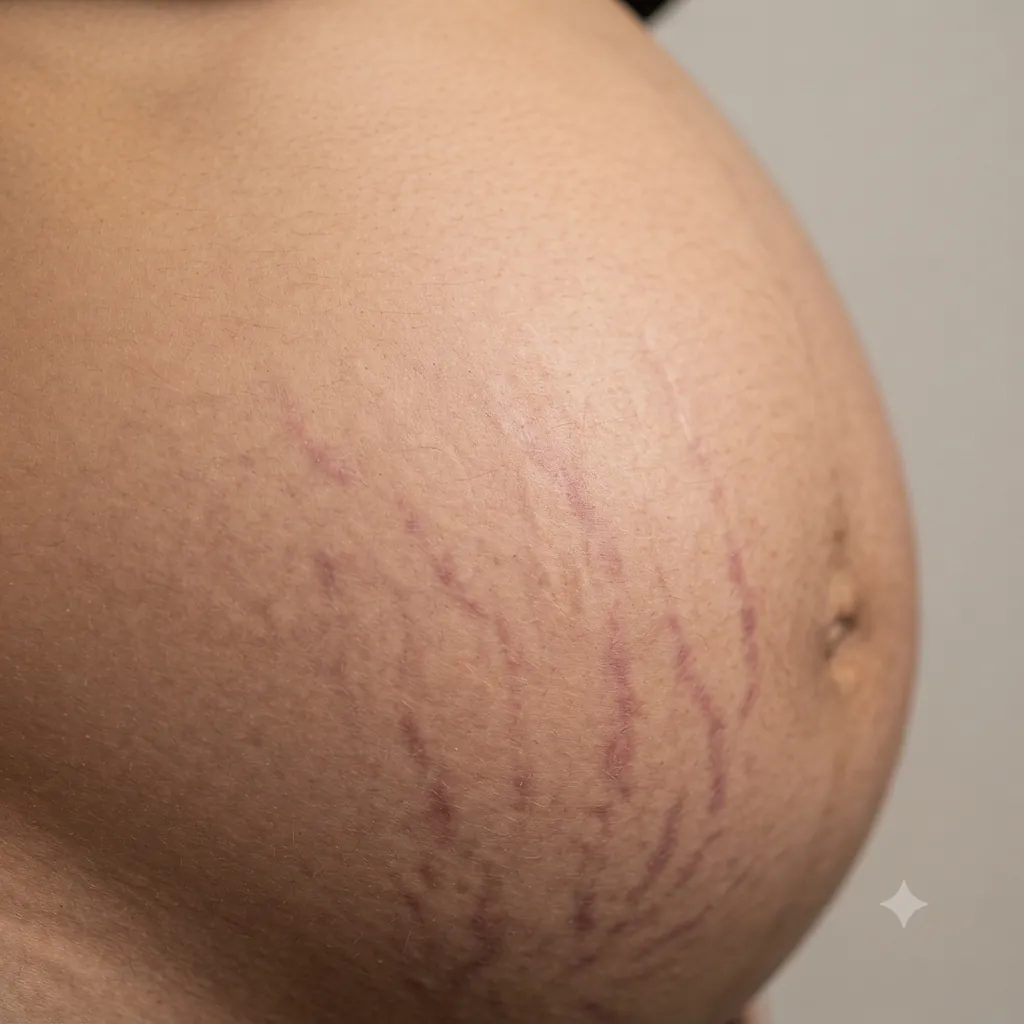
Veins vs Stretch Marks
A visible vein is a blood vessel showing through the skin. It can be a fine red web, a flat blue-green line, or a ropy cord you can feel standing up from the surface. Stretch marks are scars in the skin left by stretching too fast. They sit flat or slightly sunken, start red or purple, and fade to silver over years. Anything blue, green or raised is a vein. Anything striped, flat and silver is a stretch mark.
What it is
The vessel is doing its normal job. You can see it because it has widened, or because the skin over it has thinned, or both.
The skin stretched faster than the collagen and elastin underneath could keep up with. Those fibres tore, and the mark is the scar that healed over the tear.
Colour
Surface vessels look red or purple. Deeper ones look blue or green, because of how skin scatters light. The colour is even along the whole vessel.
New marks are pink, red or purple. Over one to two years they fade to pale silver or white and stay that way.
The pattern
Vessels split, join and change width along their length. A web spreading from one point, or a single line wandering across the skin.
Bands of a similar width, running side by side, all pointing the same way. They do not branch and they do not cross.
Can you feel it
Spider veins are flat. Reticular veins are flat or barely raised. A varicose vein is a soft ropy cord you can feel standing proud of the skin.
The surface may feel a little thinner or crinkly. There is never anything standing up.
What happens when you press
Press firmly and the colour drains out of the vessel. Let go and it comes back within a second or two.
The colour does not move under pressure. There is nothing inside a stretch mark to squeeze out.
Where it shows up
Legs most of all, because gravity works against the veins there. Also the backs of the hands, the forearms, the chest and the cheeks.
Thighs, hips, backs of the knees, stomach, breasts, upper arms and lower back. Growth spurts, weight changes and rapid muscle gain from lifting.
What it does over time
Veins do not fade. Skin thins with age, so more of them show. Standing for work and a family history both speed that up.
The colour fades a lot. The texture change stays. A silver stretch mark is a settled scar that has become hard to see.
When it needs a doctor
Visible veins alone are cosmetic. Aching or heavy legs, ankles that swell by evening, skin around an ankle turning brown or hard, or one leg suddenly swollen and painful, all need looking at.
Stretch marks are harmless. Marks that appear suddenly, are wide and purple, and come with weight gain around the middle are worth mentioning to a doctor.
The three kinds of visible vein
Spider veins are the smallest: Hair-thin red or purple threads under a millimetre wide, webbing out from a point. They are flat, and they are the ones most often mistaken for a new stretch mark.
Reticular veins are the middle size: Flat blue or blue-green lines, one to three millimetres wide, usually on the outer thigh or behind the knee. They are the ones people describe as looking like a road map.
Varicose veins are the largest: Wider than three millimetres, twisting, and raised enough to feel with a fingertip. They often ache after a long day standing.
Two tests that settle it in seconds
Run a fingertip across it: A varicose vein is a cord you can feel. A stretch mark is level with the skin or slightly below it. This one test rules out the biggest veins immediately.
Then press and lift: Press a vein and the colour empties, because you are pushing blood out of it. Lie down and raise the leg and the same thing happens, because the blood drains away. A stretch mark is unchanged by both.
Why veins become more visible with age
Skin gets thinner: The layer over the vessels loses collagen and fat, so vessels that were always there start to show through. That is why hand and chest veins become obvious in people who have not changed at all.
Low body fat has the same effect: Athletes and lean people often have prominent forearm and hand veins. That is normal anatomy showing, not a vein problem.
Leg veins are a separate story: Small valves inside them keep blood moving upward against gravity. When those valves leak, blood pools, the vein widens and it pushes up against the skin. That is what makes leg veins ache in a way that hand veins never do.
What treatment does for each
Veins can be closed: Sclerotherapy seals a vein with an injection. Vascular lasers do it with heat. Larger leg veins are closed with heat or glue through a pinhole. These are day procedures, and results on visible veins are usually clear.
Stretch marks can be faded: Prescription retinoids, vascular lasers and microneedling all help while a mark is still red and active. Silver marks are settled scars and improve very little. Nothing in a tub reverses a tear in the dermis.