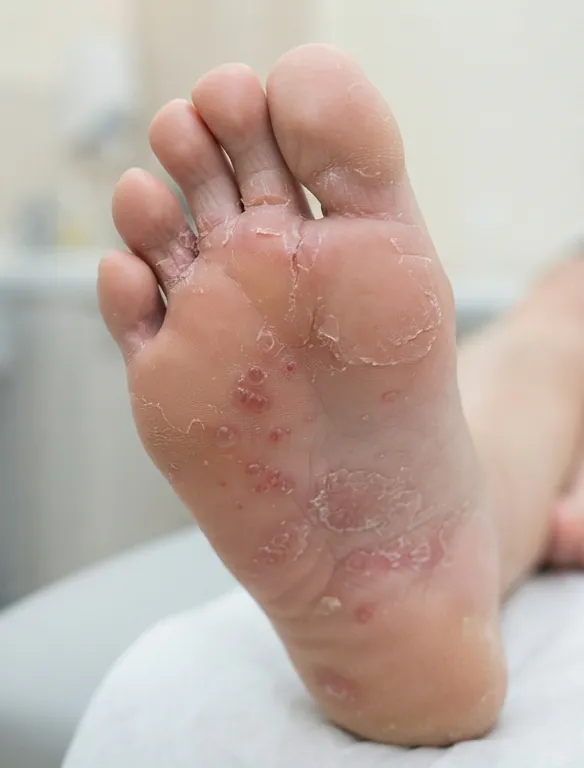
Dyshidrotic Eczema vs Athlete's Foot
Dyshidrotic eczema is an itchy blister rash, and it is not an infection. Deep, tiny blisters come up on the sides of the toes and the arch, usually on both feet and often on the hands as well. Athlete's foot is a fungal infection. It starts between the toes as soft, split, peeling skin, usually on one foot before the other.
What it is
A form of eczema. The skin barrier reacts and fluid collects in the top layer, which lifts into blisters. There is nothing living in the skin, and nothing to catch.
Dermatophytes feed on keratin in the outer layer of skin. They arrive from a damp floor or a shared towel, and warm shoes let them settle.
What it looks like
Clear blisters a millimetre or two across, sitting deep in the skin so they look buried rather than raised. They dry out after a couple of weeks and the skin peels in rings.
Soft white skin in the toe webs with a crack at the base. On the sole it can be dry scale over the heel and up the sides. One version does make blisters, usually on the arch.
Does it itch
Many people feel a burning itch a day before anything appears. Scratching turns the blisters into raw, weeping skin.
Worst between the toes, and worst when the shoes come off.
Where it shows up
Along the edges of the toes and fingers, the arch of the foot and the palms. It does not settle in the tight space between the toes.
Most often the gap between the fourth and fifth toes, spreading to the sole, the sides of the foot and the toenails.
One foot or both
It comes up on both sides at once, in a matching pattern. The hands are often involved in the same flare.
A fungal infection has to spread from where it landed, so one foot is usually ahead of the other for a while.
What sets it off
Flares follow hot weather, sweaty hands and feet, stressful stretches, and contact with nickel or cobalt in some people. It comes in waves for years.
Gyms, pools, communal showers, and shoes that never fully dry out. It stays until it is treated.
What actually treats it
A prescription steroid ointment settles a flare. Cool soaks, thick moisturizer and keeping the feet dry shorten it. Stubborn cases have other prescription options.
Terbinafine or clotrimazole from the drugstore, twice a day. Terbinafine clears more infections and does it in about a week, where clotrimazole takes about four.
When it needs a doctor
Also if the blisters are large, painful, or the skin has become raw and crusted.
Or if the toenails have turned thick, crumbly and yellow, which needs different treatment.
The blister version of athlete's foot is the one that fools people
Athlete's foot has more than one shape. The common one peels between the toes. A less common one makes small blisters, usually on the arch or the instep, and that version can look almost the same as dyshidrotic eczema.
Two things separate them at home. Blistering athlete's foot usually has peeling skin somewhere else on the same foot, most often the toe webs. And it tends to be worse on one foot.
Dyshidrotic eczema arrives on both feet in a matching pattern, and the toe webs are usually clear.
Steroid cream on a fungal infection makes it worse
A steroid cream is the right treatment for dyshidrotic eczema: It calms the inflammation that is causing the blisters, and a flare usually settles within a week or two.
A steroid cream on athlete's foot quiets the itch and lets the fungus spread: Steroids turn down the immune response that was holding the infection back. The rash looks better for a few days, then comes back larger, with a fainter edge that is harder to recognise.
This is the main reason a scraping is worth doing before starting a steroid on a foot rash you are not sure about.
Blisters on the hands from a fungus on the feet
Some people get an itchy blister rash on the palms and fingers while a fungal infection is active on their feet. The hands are not infected. It is an immune reaction to the fungus somewhere else, and doctors call it an id reaction.
The clue is the order. Feet first, hands after. Treating the feet clears the hands.
If the hands and feet both flare together and nothing on the feet looks infected, dyshidrotic eczema is more likely.
What helps either one while you work it out
Keep the feet cool and dry. Sweat makes both conditions worse, so change socks during the day and let shoes dry fully between wears.
Do not pop the blisters. Intact skin is the barrier that keeps infection out, and a burst blister on a foot takes far longer to heal than one left alone.
Skip the hot soaks. Hot water strips the skin and leaves it more irritable. Cool or lukewarm is better for both.