Melasma vs Age Spots
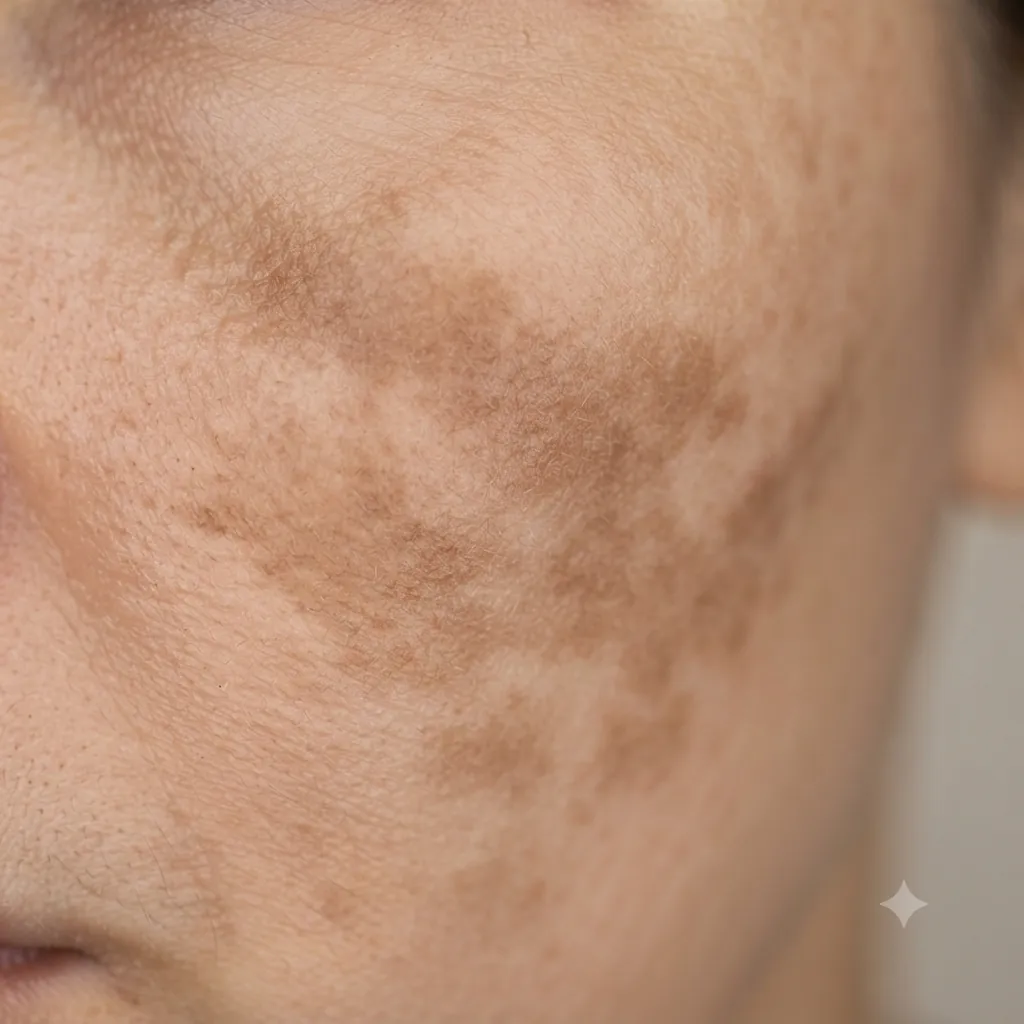
Melasma is a soft-edged brown patch that covers a broad area and usually matches on both sides of the face. It darkens in summer and fades over the winter. Age spots are separate brown spots with a clean edge, and they never fade. Age spot, sun spot, liver spot and solar lentigo are four names for that same mark.
What it is
Sun, heat and hormonal changes all push your pigment cells to lay down extra melanin. The cell count is normal. The output is not.
Each spot is a small area where repeated ultraviolet light has left the pigment cells permanently overproducing. Age itself is not the cause.
What it looks like
Fairly even brown across both cheeks, the forehead, the upper lip or the jawline.
Round or oval, from a few millimetres to about a centimetre, with normal skin in between.
The edge
The colour fades out into the skin around it. There is no line where it stops.
Every spot has a border you could draw around.
Where it shows up
Cheeks, forehead, upper lip and jawline. Cover half your face in the mirror. If the two sides broadly match, that points to melasma.
Face, backs of the hands, forearms, chest and shoulders. Drivers often have more on one side of the face.
What it does over time
Lighter through the winter, darker from spring onward. It rarely clears once and stays clear.
Spots look the same in January as in July, and new ones keep appearing while the sun exposure continues.
How it is treated
Daily broad-spectrum sunscreen matters more than anything else. Hydroquinone, azelaic acid, tranexamic acid and gentle peels fade it. Lasers are used carefully, if at all.
Cryotherapy, lasers and intense pulsed light clear individual spots well, often in one or two sessions. Creams work more slowly.
Age spot, sun spot and liver spot are one mark
These names all describe the same thing: The medical term is solar lentigo. Sun spot, age spot and liver spot are the everyday versions, and dermatologists use them interchangeably in the room.
So do not try to tell an age spot from a sun spot: There is no difference to find. If a website is comparing them, it has invented a distinction that does not exist.
The word "age" is the misleading part
Age spots are made by sun, not by ageing: They build up with the total amount of light your skin has taken over a lifetime, which is why most people start seeing them from their thirties onward.
The proof is where they land: Backs of the hands, forearms, face, chest and shoulders. Skin that stays covered ages at the same rate and does not get them.
The liver has nothing to do with it either: That name is old and comes from the colour of the spot.
Two tests, thirty seconds
Trace the outline with your eye: An age spot has an edge. Melasma does not, and that single check settles most cases.
Then compare the two sides of your face: Melasma is roughly symmetrical, because it is driven by something happening inside the skin. Age spots follow wherever the light happened to fall, so the sides usually differ.
What each one needs
Age spots respond well to being removed one at a time: Freezing, lasers and intense pulsed light clear them in one or two sessions, and sunscreen slows new ones from forming.
Melasma responds to sun protection and patience: It is managed rather than cured, and it comes back when the sunscreen stops. Heat and light aimed at it can make it worse.
See a doctor if
One spot is changing in shape, colour or size
One spot looks clearly different from all the others
A dark spot bleeds, itches, crusts or will not heal
A flat brown patch is slowly widening with a ragged edge
A brown patch keeps spreading despite daily sunscreen
You want a spot treated and are not sure which kind it is