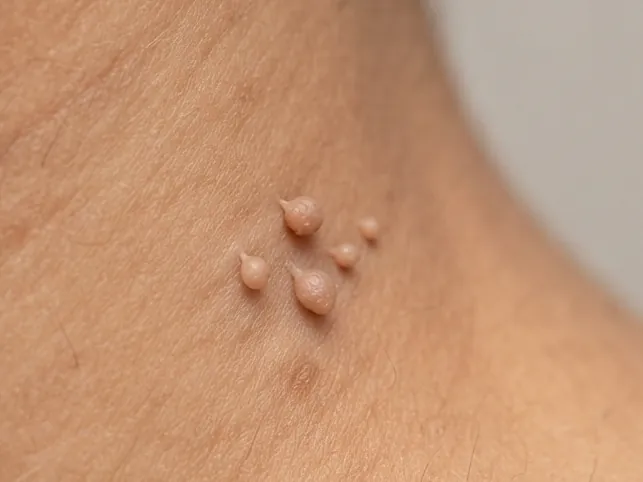
Milia vs Sebaceous Hyperplasia
Milia are tiny keratin cysts sealed just under the surface of the skin. They are white, firm, smooth on top, and about the size of a pinhead. Sebaceous hyperplasia is an oil gland that has grown too large. Those bumps are yellowish, softer, a little bigger, and most have a small dip in the middle. Look for the dip. A dimple in the centre means sebaceous hyperplasia.
What it is
Keratin is the protein that makes up the surface of your skin. A small amount gets sealed into a closed pocket, with no opening for it to come out of.
The gland keeps making oil but drains poorly, so it swells and pushes the skin up. The bump is the gland itself, not a blockage sitting inside a pore.
What it looks like
Round, dome-shaped, even in colour, with no opening and no dip on top. It looks like a grain of sand under the skin.
Soft, doughnut-shaped, cream to yellow, with a small crater in the middle. Fine blood vessels often run across the surface, but they stop at the edge of the bump.
Size
Pinhead-sized, and it stays that size.
Bigger than a milium, and often a small group sits together on the forehead or a cheek.
Does it feel hard or soft
Press it and there is a firm bead that does not squash. Nothing comes out, because there is no opening.
It gives under a fingertip. Squeezing can push out a little oil, and the bump refills within days.
Where it shows up
Eyelids and under the eyes most of all, then the nose, cheeks and forehead. Newborns get them across the nose and chin.
The oiliest parts of the face, in adults from about their forties onwards.
What it does over time
Milia in babies clear within a few weeks. In adults they often sit quietly for months, and some stay for years.
An individual bump does not resolve. New ones tend to arrive on the same areas over the years.
How it is treated
A clinician opens the surface with a sterile needle and lifts the keratin out. It takes seconds per bump, usually needs no anaesthetic, and heals over within about a week.
Electrocautery flattens the gland with a fine heated tip. Laser and trichloroacetic acid do the same job. Each bump takes a few seconds, and one treatment usually settles it.
When it needs a doctor
Milia are harmless. The reason to hand this over is that eyelid skin is thin and easy to mark.
Sebaceous hyperplasia is harmless too. But a yellow bump that keeps growing, bleeds or crusts is worth checking, because basal cell carcinoma can look similar.
The centre of the bump settles it
A milium has a smooth, unbroken top: Nothing dips, nothing opens, and the colour is white or pale cream right across the dome.
Sebaceous hyperplasia has a crater in the middle: Stretch the skin gently and look in good light from the side. The rim sits up and the centre sinks, so it looks like a tiny doughnut. That dip is where the gland's duct opens onto the surface.
Why one squeezes and one does not
Milia cannot be squeezed out: The pocket is sealed. Pressure only bruises the thin skin over the top, which on the eyelid leaves a brown mark or a small dent. This is a two-minute job for someone who does it every week.
Sebaceous hyperplasia comes back when you squeeze it: A little oil comes out, the bump looks flatter for a day, and then the gland refills. The gland is still there. Only treatments that shrink or destroy the gland make a lasting difference.
What creams do for each one
A retinoid cream clears milia slowly: It speeds up how fast the surface layer sheds, which helps trapped keratin work its way out. Expect weeks to months, not one evening.
A retinoid cream helps sebaceous hyperplasia a little: It can keep new bumps from forming and soften the look of the ones you have, but it will not flatten an established gland. Isotretinoin tablets shrink these glands well, and the bumps usually return after the course ends.
What else looks like both
Closed comedones: Plugged pores. Softer than milia, skin-coloured rather than white, and they respond to acne treatment.
Syringomas: Small firm skin-coloured bumps in clusters under the eyes. They come from sweat glands.
Basal cell carcinoma: A pearly, translucent bump with vessels running over it. The vessels cross the whole surface, and the bump slowly grows.