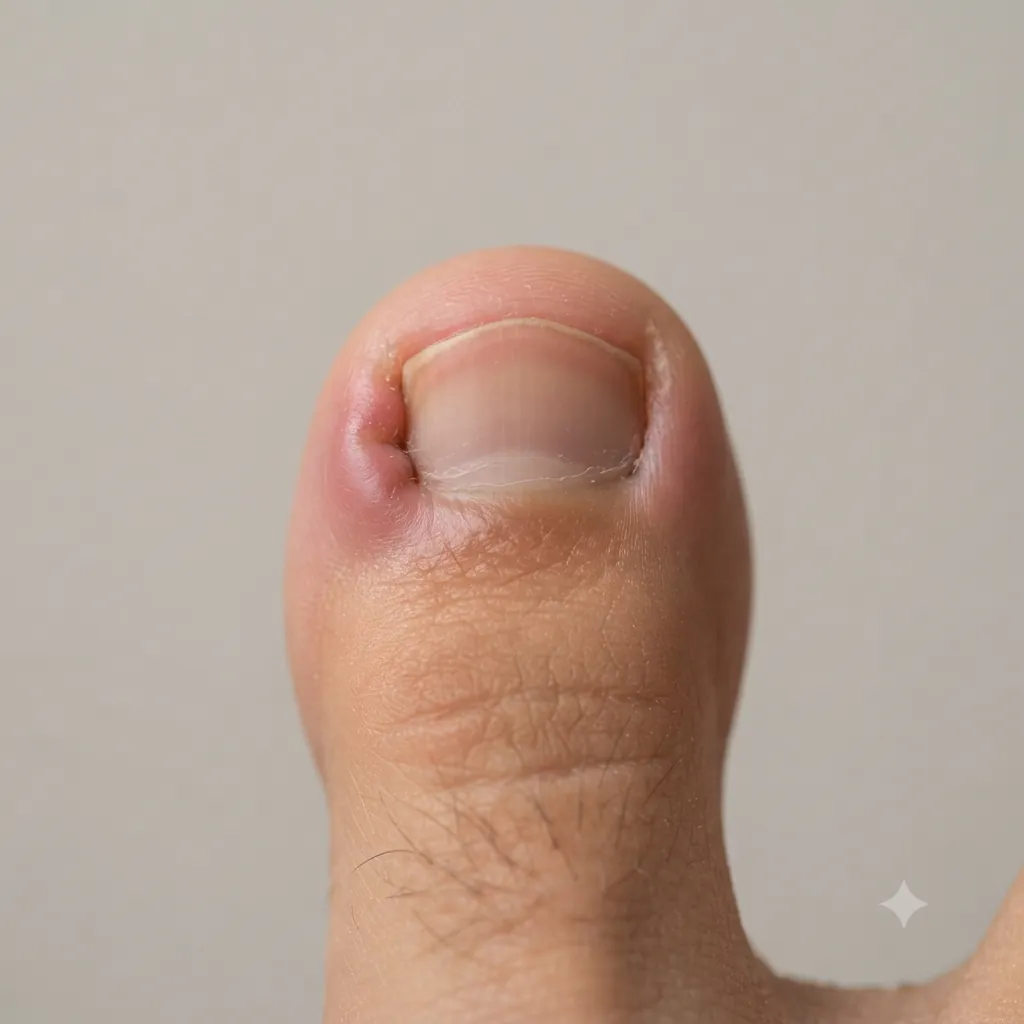
Paronychia vs Ingrown Toenail
Paronychia is an infection of the skin fold beside a nail. The fold turns red, puffy and tender, often with a bead of pus, and it happens on fingers as well as toes. An ingrown toenail is a nail edge growing into the skin, on a toe, almost always the big toe. They overlap more than most pairs: an ingrown nail breaks the skin, and a break in the skin is exactly how paronychia starts.
What it is
Bacteria get through a break in the fold of skin that seals the edge of the nail. Your body walls them off and pus collects.
The edge of the nail pushes into the soft skin fold beside it. The skin reacts like it would to a splinter. Nothing is infected at the start.
What it looks like
Redness that follows the curve of the nail fold. The skin looks tight and glossy. A yellow or white pocket often shows through, and the fold may lift away from the nail.
The nail itself looks normal. The skin next to it is swollen and shiny, sometimes with a small bead of fluid at the corner.
Does it hurt
Pain builds over a day or two and beats on its own, not only when touched. A large pocket of pus is tender to the lightest pressure.
Throbs in a tight shoe, hurts when a bedsheet presses on it, and is tender to touch on that one side.
Where it shows up
Most often a finger. Thumb and index finger are common, because they take the most nail biting, hangnail picking and manicure work.
Almost always the outer or inner corner of the big toe. One side at a time.
What starts it
Nail biting, picking a hangnail, aggressive cuticle trimming, a splinter, or hands that are wet all day.
Cutting the nail too short or rounding the corners, narrow shoes, a knock to the toe, sweaty feet, or a naturally curved nail.
What it does over time
An acute infection worsens quickly and settles fast once the pus is released. The chronic finger version comes and goes for months and leaves a ridged, dull nail.
Days to weeks. The skin can pile up over the nail edge and start to weep. It settles fast once the nail stops digging in.
How it is treated
Warm soaks help early. A collected pocket needs a clinician to numb the area and drain it, which relieves it immediately. Antibiotics are added when redness spreads. The chronic version needs the hands kept dry more than it needs antibiotics.
Warm salt-water soaks, roomier shoes, and a clinician lifting or trimming the offending corner. A stubborn one is treated by numbing the toe and removing a narrow strip of nail edge.
How long until it settles
The chronic hand version takes weeks to months, and the nail looks rough for longer.
An ingrown toenail can turn into paronychia
This is the overlap that confuses people: The nail edge cuts the skin fold. That break lets bacteria in. Now you have both problems in the same toe, and the second one was caused by the first.
You can usually tell when it has happened: An uncomplicated ingrown nail is sore, red and firm. Once it is infected, you get pus, a shinier and more swollen fold, sometimes lumpy pink tissue growing over the nail edge, and pain that jumps in a day.
Treating only the infection means it comes back: Draining pus and taking antibiotics helps for a week or two. If the nail spike is still buried in the skin, the fold gets injured again and the infection returns. The nail edge has to be dealt with for the toe to stay well.
Not every paronychia involves a nail edge
Most paronychia has nothing to do with an ingrown nail: On fingers it usually follows nail biting, a torn hangnail, or cuticle work at a manicure. The cuticle is a seal, and once that seal is broken, bacteria get underneath it.
The long-running version is a different problem: Chronic paronychia sits on the hands of people who are wet-handed all day: bartenders, cleaners, nurses, parents of small children. It is driven by repeated wetting and yeast rather than one bacterial infection, so it swells, settles and swells again over months. Antibiotic courses do not fix it. Keeping the hands dry and wearing gloves does more.
The quick test at home
Look at the nail edge first, then the fold.
The nail corner is buried in the skin: Ingrown toenail, whether or not it is infected too.
The fold is swollen with pus and the nail edge is where it should be: Paronychia.
The corner is buried and there is pus: Both, and the nail edge is the reason.
A finger, not a toe: Paronychia. Fingernails do not go ingrown the way toenails do.
How to keep each one away
Ingrown nails come back from how the nail is cut: Cut straight across, no shorter than the tip of the toe. Rounding the corners leaves a spike of nail that the skin grows over. Roomy shoes matter as much as the trimming.
Paronychia comes back from what you do to your cuticles: Clip hangnails rather than tear them, and ask for cuticles to be pushed back, not cut. If your hands are wet all day, gloves are the treatment.
See a doctor if
There is pus, or the fold is swelling by the day
Redness is spreading up the finger or across the foot
The nail is lifting away from the bed
Lumpy pink tissue has grown over the nail edge
The same toe goes ingrown again and again
A finger infection is spreading into the fingertip pulp, which becomes tense and very painful
You have diabetes, neuropathy or poor circulation, in which case do not treat either one at home