Profhilo vs Rejuran
Profhilo is better for skin that looks dry, dull or slightly loose. It is a hyaluronic acid gel that spreads under the skin to hydrate and mildly firm it, given as two visits a month apart. Rejuran is better for rough texture, fine lines, shallow acne scars and skin that is thin or easily irritated. It uses polynucleotides, which are fragments of salmon DNA, and runs as three visits. Both are courses rather than one appointment, and both are repeated once or twice a year.
What is in the syringe
A thin gel that spreads out under the skin instead of staying in one spot. Hyaluronic acid is a sugar your skin already makes, and it holds water.
Purified DNA fragments. Not a filler, and no volume.
What it improves
Skin that looks dry and tired, and early looseness along the cheek and jaw. Also used on the neck, chest and hands.
Fine lines, rough texture, shallow acne scars, large pores, and skin that reacts to everything.
Where it goes
Standard spots along the cheek, jaw and chin. The gel then spreads out from there.
Spread evenly through the skin, a few millimetres down.
How soon you see something
Skin often looks brighter early. The firmness needs both sessions and about four to six weeks.
Nothing changes on the day. Texture comes first, then fine lines.
How many sessions
That pair is the course. Top-ups later are usually one visit.
Then one session every six to twelve months.
How long it lasts
What it feels like
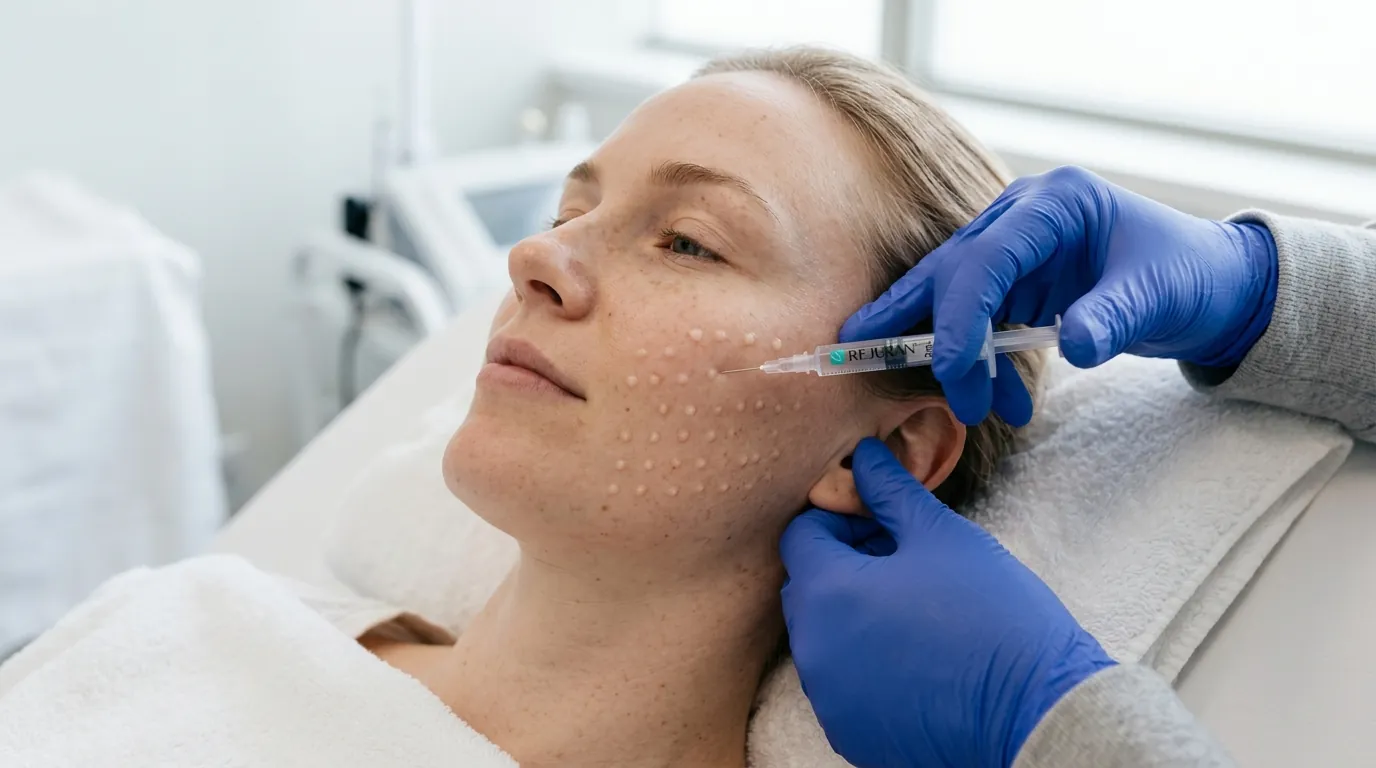
Small bumps like mosquito bites at each point. They flatten within a day or two.
More injections than Profhilo, so it takes longer and is the less comfortable of the two.
What it will not do
Profhilo hydrates. Skin can look plumper while the surface still feels uneven.
Rejuran does not add volume. A flat cheek stays flat.
Cost
Ask for the price of both sessions together.
Three sessions usually costs more than a Profhilo course.
The at-home or drugstore version
A hyaluronic acid serum holds water in the top layer for a few hours. Profhilo is placed a few millimetres down, where collagen lives.
PDRN creams and ampoules exist and feel pleasant. Injected polynucleotides are placed inside the skin, which a cream cannot do.
Who each suits
They are aimed at two different complaints
Profhilo is aimed at skin that has gone dry and slack: The gel holds water and spreads, so the whole area looks plumper and slightly firmer. The change is easiest to see on a cheek or a neck that has started to look thin.
Rejuran is aimed at the surface itself: It is chosen for skin that is rough, marked or reactive rather than skin that has lost tone. People often pick it for shallow acne scarring and enlarged pores.
Neither one replaces a filler: If you can point at a hollow in the mirror, neither of these will fill it.
Can you have both
Clinics often run them together, at separate visits: The usual reasoning is that one hydrates and one repairs, so they do not overlap.
There is no evidence the pair beats either one alone: Doing both doubles the cost and doubles the appointments, so it is fair to ask what you would be getting for that.
Doing one properly is a reasonable first step: Pick the treatment aimed at your main complaint, finish the course, and judge it before adding anything.
Where these are used
Neither one is approved in the United States for these uses: Profhilo is used across Europe, Asia and much of the world. Rejuran is widely used in Korea. Some US clinics offer them anyway. Ask what a clinic uses, and where it comes from.
Has anyone compared them directly
No trial has put Profhilo against Rejuran: Each has its own small studies measuring skin before and after. Any claim that one beats the other comes from clinic experience, not from a comparison.
Before you book
Describe the problem rather than naming a product. Dull and slack leads one way, rough and marked leads the other.
Ask for the total cost of the course, not the price of one visit.
Ask how many injection points to expect, so the bumps afterwards are not a surprise.
Leave a clear few days before anything social. Both leave marks for a day or two.
If a clinic recommends both, ask which to do first and why.