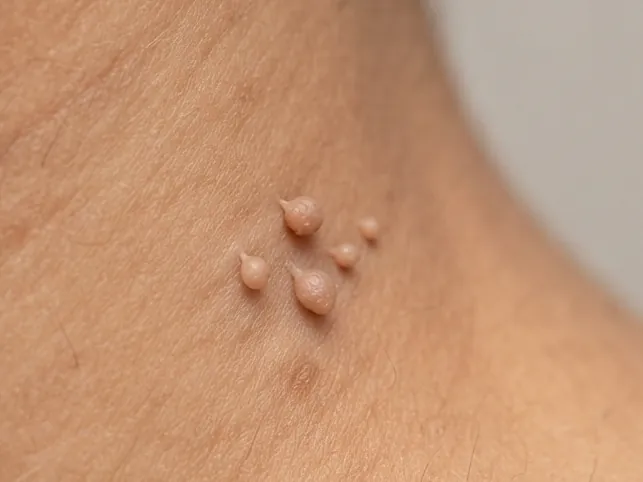
Xanthelasma vs Milia
Xanthelasma is a soft yellow patch of cholesterol sitting under the skin of the eyelid. It is flat or slightly raised, wider than it is tall, and it usually starts at the inner corner near the nose. Milia are tiny white keratin cysts. They are round, hard, and about the size of a pinhead. Yellow and flat means xanthelasma, white and beady means milia. Only one of the two is a reason to have your cholesterol checked.
What it is
Fat-carrying cells collect in the dermis and build up into a soft plaque. The yellow colour is the cholesterol itself.
Keratin is the protein that makes up the surface of your skin. A small amount gets sealed into a closed pocket, with no opening for it to come out of.
What it looks like
Cream to butter-yellow, with a soft edge that blends into the skin. It often looks like a smear or a streak rather than a bump.
Round, dome-shaped, bright white or pale cream, with a clean edge. It looks like a grain of sand under the skin.
Size
It spreads sideways over months and can join up into a longer band along the lid.
Pinhead-sized, and it stays that size.
Where it shows up
Usually the upper lid nearest the nose, and it is often on both eyes and both lids in a matching pattern.
Under the eyes and on the lids, then the nose, cheeks and forehead. Scattered rather than symmetrical.
How it feels
Press it and it gives, like a small pad under the skin. There is no hard core.
A solid bead that does not squash. Nothing comes out however hard you press, because it is sealed.
What it does over time
Xanthelasma does not resolve on its own. Most get slowly bigger, and new patches appear on the other lids.
Milia in babies clear within weeks. In adults they often sit quietly for months, and some stay for years.
How it is treated
Trichloroacetic acid, laser, liquid nitrogen or a small excision all work, and eyelid skin heals well. Recurrence is common whichever method is used.
A clinician opens the surface with a sterile needle and lifts the keratin out. It takes seconds per bump and heals over in about a week.
When it needs a doctor
Xanthelasma is harmless in itself, but it can be the first outward sign of a lipid problem. Anyone who develops it should have their cholesterol checked, especially under the age of 40.
Milia are harmless and mean nothing about your health. Worth checking if a crop appears on skin that was burned, blistered or scarred.
Shape is the fastest test
Xanthelasma is a patch: It is wider than it is high, with edges that fade rather than stop. Look at it in the mirror and you see an area of colour, not a bump.
A milium is a dot: It is a discrete round bead with a definite edge. You can count them. You cannot really count xanthelasma, because it is one continuous area.
What xanthelasma says about your health
About half of people with xanthelasma have normal cholesterol: So it does not confirm high cholesterol on its own, and plenty of people with it have perfectly ordinary blood results.
The other half do not: High LDL cholesterol, low HDL cholesterol and raised triglycerides are the usual patterns found. Large population studies have also linked xanthelasma to a higher risk of heart disease even when cholesterol readings come back normal.
The useful step is a blood test, not worry: A standard lipid panel from your doctor answers the question in one appointment. If the result is normal, the patch is simply a cosmetic matter.
Treating the skin and treating the cause
Removing the patch does not change what caused it: Acid, laser and surgery all clear the visible plaque. If the underlying lipid level stays high, the plaque is more likely to return.
Lowering cholesterol does not usually clear the patch: Diet changes and statins help the numbers and the long-term risk. An established xanthelasma rarely fades much on its own, so most people treat both separately.
What else is yellow near the eye
Sebaceous hyperplasia: A yellow bump with a dip in the middle, on the forehead and cheeks more than the lids.
Syringomas: Small firm skin-coloured bumps clustered under the lower lids.
Pinguecula: A yellow patch on the white of the eye itself, not on the lid skin.