Gout vs Ingrown Toenail
Gout is a joint problem, not a skin problem. Uric acid crystals form inside the big toe joint, and the whole joint turns red, hot and swollen, usually overnight. An ingrown toenail is a skin problem at the edge of the nail. One corner of the nail digs in, and only that corner is sore. Point at what hurts: the knuckle at the base of the toe is gout, the nail corner is an ingrown nail.
What it is
Uric acid builds up in the blood over years and forms needle-shaped crystals in a joint. The body reacts to the crystals, and that reaction is the pain and swelling.
The edge of the nail pushes into the soft skin fold beside it. The skin reacts the way it would to a splinter. Nothing is infected at the start.
What it looks like
Shiny, dusky red or purple skin over the base of the big toe, and a joint that looks two sizes too big. The skin often peels as the flare settles.
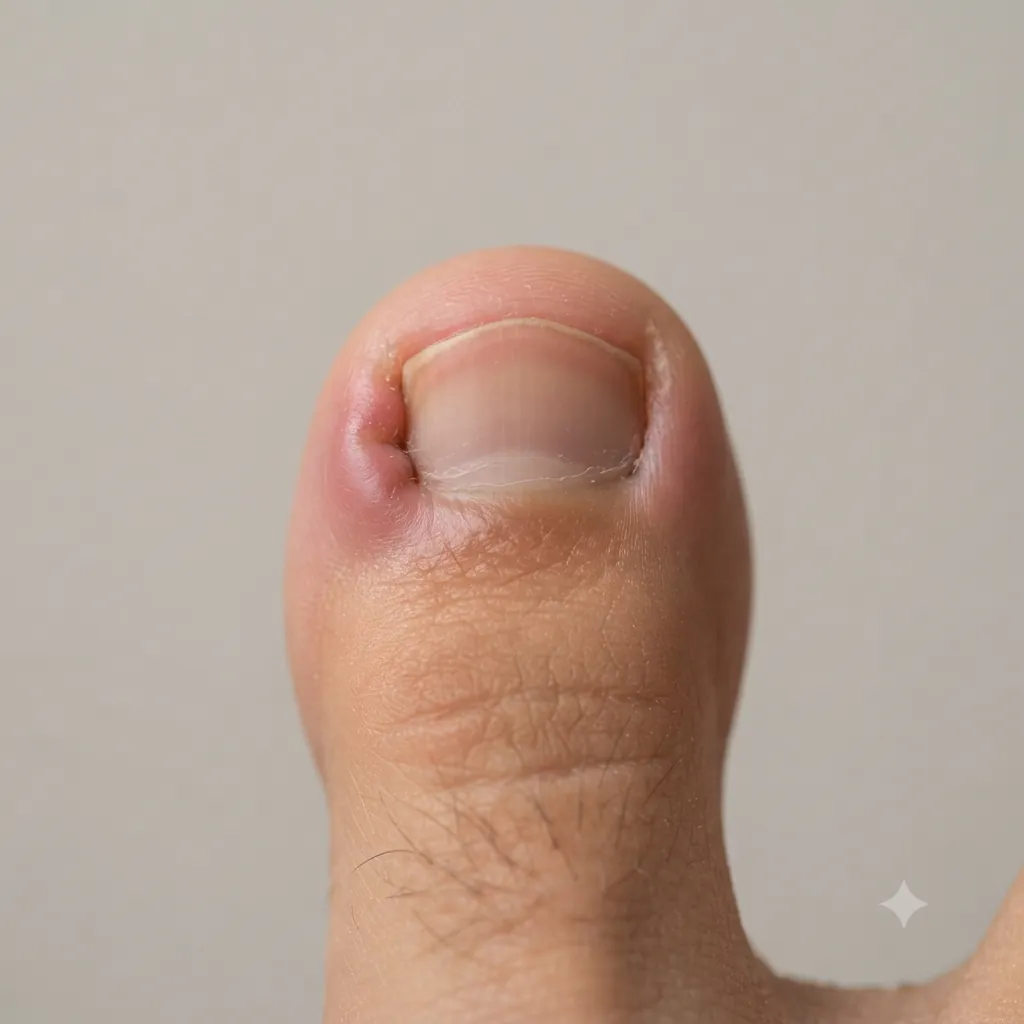
The nail itself looks normal. The skin at one corner is swollen and shiny, sometimes with a bead of yellow fluid.
Where it hurts
The joint where the toe meets the foot. The nail end of the toe usually feels fine.
The tip of the toe, on one side only. Pressing that corner reproduces the pain exactly.
How it starts
Many people go to bed well and wake at two in the morning unable to bear the weight of a sheet.
Tender first, then sore in shoes, then throbbing. There is usually a week of warning.
How much it hurts
The joint is exquisitely tender to the lightest touch, and walking is difficult during a flare.
Uncomfortable in a tight shoe, and tender when the corner is pressed. Bearable in an open shoe.
What it does over time
A flare fades on its own, and between flares the toe feels normal. Untreated, flares come back and can involve other joints.
It will not settle while the nail is still digging in. Left alone, the skin piles up over the edge and can start to weep.
How it is treated
A flare is calmed with anti-inflammatory medicine. Repeat flares are prevented with a daily tablet that lowers uric acid, which is a long-term treatment rather than a course.
Warm salt-water soaks, roomier shoes, and a clinician lifting or trimming the corner. A stubborn one is treated by numbing the toe and removing a narrow strip of nail edge.
When it needs a doctor
A first flare should be confirmed rather than guessed at, because the treatment that prevents the next one depends on blood tests and a proper diagnosis.
Worth a visit if the fold is oozing, if lumpy pink tissue has grown over the nail edge, or if the same toe goes ingrown again and again.
Point at what hurts
Ask someone to press two places: Press the joint at the base of the big toe, where it meets the foot. Then press the corner of the nail at the tip.
Gout hurts at the base and an ingrown nail hurts at the tip: That single test separates them most of the time, because the two problems live at opposite ends of the same toe.
The shape of the swelling helps too: Gout swells the whole joint, so the toe looks fat and the redness wraps all the way around. An ingrown nail swells one side of one corner, and the rest of the toe looks normal.
Gout is not a skin condition
The skin over a gouty joint is a passenger: It turns red, shiny and warm because of the inflammation underneath, and it often peels for a few days as the flare fades. That peeling is sometimes mistaken for a fungal or eczema patch.
Nothing you put on the skin will help it: Creams do not reach a joint. Gout is treated from the inside, and it is usually managed by a family doctor or a rheumatologist rather than a dermatologist.
Long-standing gout can show on the skin: Firm chalky lumps called tophi can build up over joints, on the tops of the feet, and on the edges of the ears. Those are deposits of the same crystals, and they are a sign the uric acid level has been high for a long time.